
Calculus, one of the greatest intellectual achievements in human history, has profoundly impacted science, engineering, economics, and beyond. Its development marked a significant leap in our understanding of the world and laid the foundation for modern technology. This article explores the fascinating journey of calculus from its early beginnings to its formalization and widespread application.
Early Beginnings
The roots of calculus can be traced back to ancient civilizations, where early forms of calculus-like methods were used to solve practical problems. The ancient Egyptians and Greeks, for example, made strides in geometry that hinted at the principles of calculus. Archimedes, a Greek mathematician, made significant contributions by developing methods to find the areas and volumes of shapes using a technique similar to integration.
The Pre-Calculus Era
During the Middle Ages, Islamic scholars preserved and expanded upon the mathematical knowledge of the Greeks. Persian mathematician Alhazen (Ibn al-Haytham) used early forms of infinitesimal methods to solve geometric problems, laying the groundwork for future developments.
In the 17th century, European mathematicians began to build on these earlier works. The concept of limits, a fundamental idea in calculus, started to take shape. Pierre de Fermat and Bonaventura Cavalieri made notable contributions that influenced later mathematicians. Fermat’s work on finding the tangents to curves and maxima and minima of functions was particularly important.
The Birth of Calculus
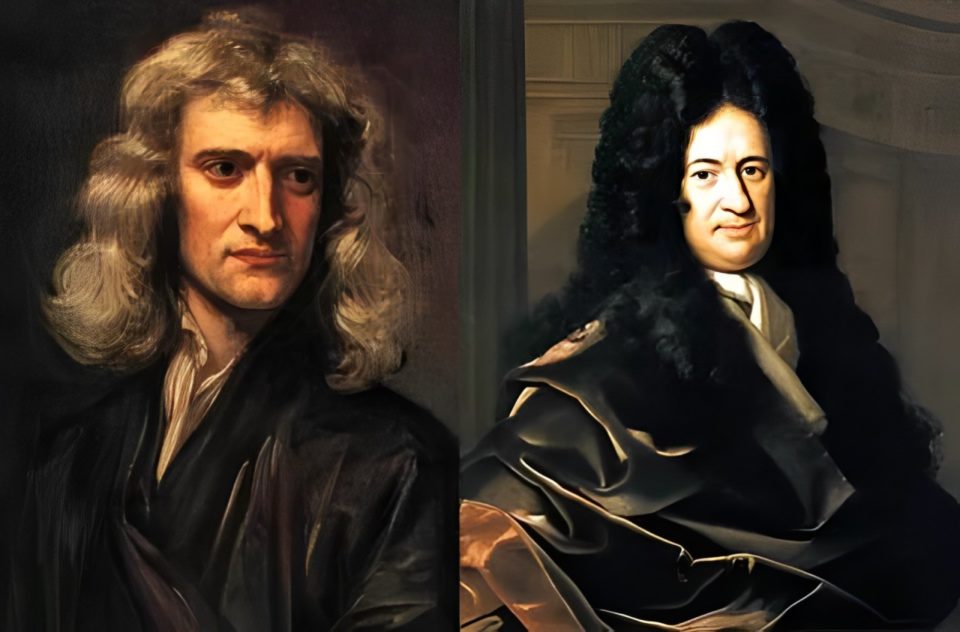
The true birth of calculus is credited to two towering figures of the 17th century: Sir Isaac Newton and Gottfried Wilhelm Leibniz. Independently of each other, Newton and Leibniz developed the fundamental principles of calculus, including differentiation and integration.
Isaac Newton (1643-1727): Newton’s work on calculus was motivated by his interest in physics and astronomy. He used calculus to describe the laws of motion and universal gravitation, providing a mathematical framework that revolutionized science. Newton referred to his methods as “fluxions” and “fluents,” focusing on changing quantities and their rates of change.
Gottfried Wilhelm Leibniz (1646-1716): Leibniz approached calculus from a more formal and systematic perspective. He introduced the notation that we use today, such as the integral sign (∫) and the derivative (dy/dx). Leibniz’s work emphasized the concept of infinitesimals and the rules for manipulating them.
The controversy over who first invented calculus led to a bitter dispute between the followers of Newton and Leibniz, known as the calculus priority dispute. Despite the rivalry, both men are now recognized for their contributions, and their combined efforts laid the foundation for modern calculus.
The Formalization of Calculus
In the centuries following Newton and Leibniz, mathematicians worked to rigorize and formalize the concepts of calculus. Augustin-Louis Cauchy, Bernhard Riemann, and Karl Weierstrass were instrumental in developing a more precise and logical foundation for calculus. They introduced the modern definitions of limits, continuity, and convergence, addressing the ambiguities present in earlier formulations.
Applications and Impact
Calculus has since become a cornerstone of mathematics, and its applications are vast. It is essential in fields such as physics, engineering, economics, biology, and medicine. Calculus allows scientists and engineers to model and solve problems involving change and motion, optimize processes, and understand complex systems.
Conclusion
The emergence of calculus is a testament to human curiosity and the relentless pursuit of knowledge. From ancient geometry to the groundbreaking work of Newton and Leibniz, and the rigorous formalizations that followed, calculus has evolved into a powerful tool that shapes our understanding of the universe. Its development is a remarkable journey of human thought, reflecting the cumulative efforts of many great minds across history. As we continue to explore and innovate, the principles of calculus remain at the heart of scientific and technological progress.
