
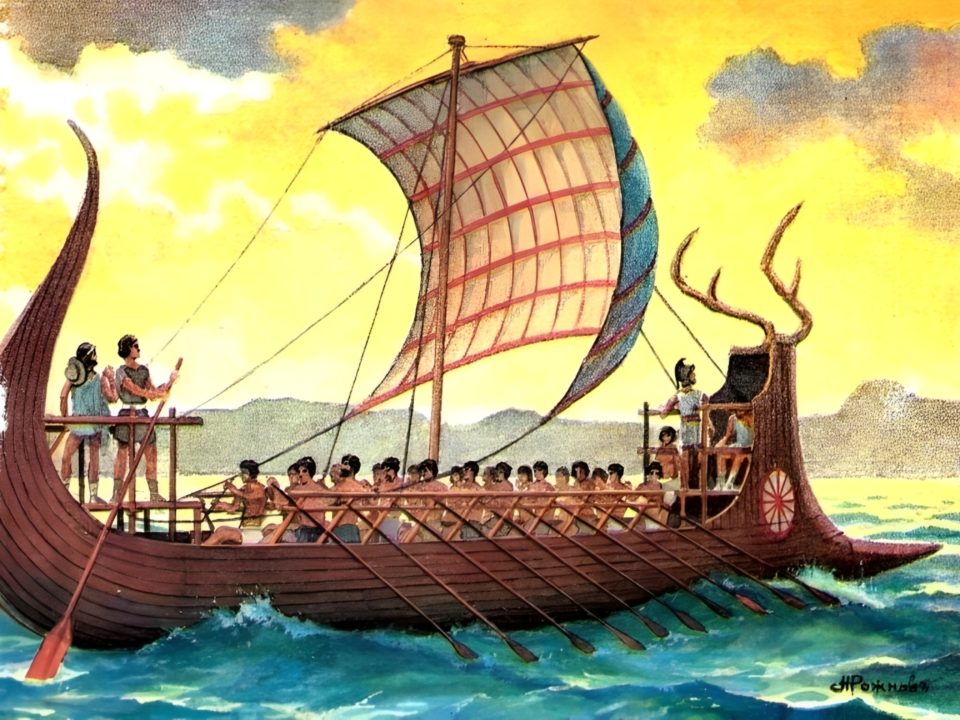
The ancient Mediterranean was a battleground for influence, trade, and territory. Among the many conflicts that shaped its history, the struggle between the Greeks and the Etruscans over Corsica stands out as a significant event. The island, strategically located in the Tyrrhenian Sea, became a contested zone between these two powerful civilizations. But how did the Etruscans succeed in driving the Greeks out of Corsica?
The Strategic Importance of Corsica
Corsica, with its central position in the western Mediterranean, was a valuable asset for any seafaring civilization. It offered key trade routes, rich natural resources, and a stronghold for expansion into other regions. The Greeks, who were establishing colonies across the Mediterranean, saw Corsica as an ideal location for settlement and trade.
The Greek Presence on Corsica
By the 6th century BCE, the Greeks had established a colony in Alalia (modern-day Aleria) on the eastern coast of Corsica. This settlement was founded by Phocaean Greeks, who had previously established Massalia (modern-day Marseille) in southern France. Their presence on Corsica was intended to expand Greek trade networks and influence in the western Mediterranean.
However, the Greek expansion threatened the interests of the Etruscans, who dominated much of central Italy and controlled maritime trade routes. Additionally, Carthage, a powerful North African city-state, also viewed the Greek presence as a threat. This led to an alliance between the Etruscans and Carthaginians to challenge Greek dominance.
The Battle of Alalia (540 BCE): The Turning Point
The decisive conflict between the Greeks and the Etruscan-Carthaginian alliance occurred around 540 BCE in what is known as the Battle of Alalia. The Greeks, led by the Phocaeans, initially had a strong naval force, but they were significantly outnumbered. The Etruscans and Carthaginians deployed a formidable fleet to confront them.
Although the battle was technically a Greek victory—meaning they managed to destroy a significant number of enemy ships—it came at a heavy cost. The Phocaeans lost a large portion of their fleet, making it unsustainable to maintain control over Corsica. Facing increasing pressure from both the Etruscans and Carthaginians, the Greeks were forced to abandon the island.
Etruscan Control and Influence
After the departure of the Greeks, the Etruscans solidified their presence on Corsica. They took control of Alalia and imposed their authority over the region. However, their rule was not long-lasting. By the 3rd century BCE, the rising power of Rome would eventually absorb both Etruscan and Carthaginian territories, including Corsica.
Conclusion
The Etruscans, with the help of their Carthaginian allies, successfully expelled the Greeks from Corsica through superior naval strategy and military pressure. The Battle of Alalia marked a turning point, demonstrating the power struggles that defined the ancient Mediterranean. While the Etruscans held the island for a time, Corsica’s fate would eventually be decided by the expanding Roman Republic.
This episode in history highlights how strategic alliances, naval warfare, and economic interests shaped the ancient world. The legacy of these conflicts can still be traced in the cultural and historical landscape of the Mediterranean today.
