
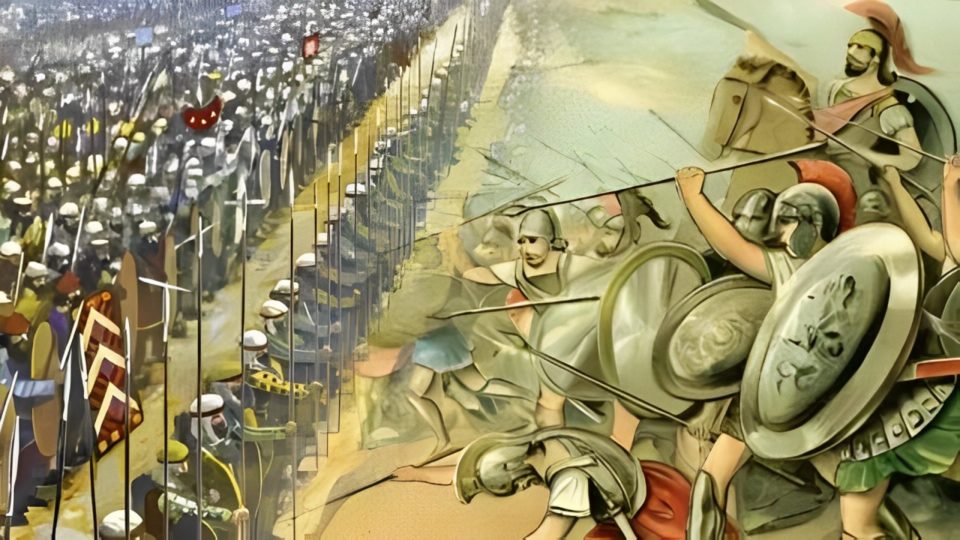
The Battle of Marathon in 490 BCE remains one of the most iconic battles in history, marking a pivotal moment in the conflict between the Greek city-states and the vast Persian Empire. Against overwhelming odds, the outnumbered Athenians secured a decisive victory, halting the first Persian invasion of Greece. This battle demonstrated the strength of Greek strategy, unity, and determination, setting the stage for future confrontations with Persia.
The Background: Persia’s Expansion and Greek Defiance
The Persian Empire, led by King Darius I, was the largest and most powerful empire of its time. Darius sought to expand his empire into Europe, punishing the Greek city-states, particularly Athens and Eretria, for supporting the Ionian Revolt—a rebellion against Persian rule in Asia Minor. In 490 BCE, Darius launched a campaign, sending a powerful fleet and army to subjugate the Greek mainland.
The Persian forces first targeted Eretria, which fell quickly, its population enslaved. Next, they turned their attention to Athens, landing on the plains of Marathon, approximately 26 miles northeast of the city. Here, the Persians prepared for an overwhelming assault, confident in their numerical and tactical superiority.
The Forces: Greeks vs. Persians
Persian Army: Estimates suggest the Persian forces numbered between 20,000 to 30,000 soldiers, including cavalry, archers, and lightly armed infantry. Their strength lay in their mobility, long-range attacks, and vast manpower.
Greek Army: The Athenian army, led by General Miltiades, fielded around 10,000 hoplites—heavily armored citizen-soldiers. Reinforcements from Plataea added 1,000 more troops, a show of solidarity among Greek states. Unlike the Persians, the Greeks relied on close combat and disciplined phalanx formations.
Despite being vastly outnumbered and lacking cavalry or archers, the Greeks had several key advantages: their superior armor, innovative strategy, and unwavering resolve to defend their homeland.
The Strategy: Miltiades’ Leadership and the Phalanx Formation
The Persian strategy relied on their archers to weaken enemy lines before engaging in direct combat. However, the Greeks had a secret weapon: the phalanx formation. This tight, rectangular arrangement of soldiers wielding large shields and long spears created an impenetrable wall of armor. It allowed the Athenians to withstand Persian arrows and close the gap for hand-to-hand combat.
Miltiades, the Greek commander, devised a bold plan:
The Athenians would advance quickly across the plain, minimizing their exposure to Persian arrows.
The center of the Greek line would appear intentionally weak to lure the Persian forces forward.
The stronger flanks of the Greek army would then encircle and crush the Persians from both sides.
This tactic required precise timing and discipline, but the Greeks had trained rigorously and were ready for the challenge.
The Battle: A Swift and Decisive Victory
The Greeks launched their attack early in the day, catching the Persians off guard. Running across the plain of Marathon, they closed the distance quickly, rendering Persian archery ineffective. The heavily armed hoplites clashed with the lightly armored Persian infantry, pushing through their ranks.
As planned, the Persian center initially gained ground, believing they were breaking through the Greek line. However, the Greek flanks swept inward, surrounding the Persians in a deadly pincer movement. Trapped and disoriented, the Persian forces suffered heavy casualties.
The Persian survivors fled back to their ships, with the Greeks pursuing them to the shoreline. Although some Persians escaped, their invasion was decisively thwarted. The Greeks had won the day, suffering minimal losses compared to the Persians.
Why Did the Greeks Win? Key Factors
Tactical Brilliance: Miltiades’ strategy to exploit Persian weaknesses—by neutralizing their archers and using the phalanx—was instrumental. The Greeks capitalized on their superior close-combat abilities.
Greek Armor and Discipline: The hoplites’ heavy bronze armor, large shields, and spears gave them a significant advantage over the lightly equipped Persians. Their disciplined formation ensured cohesion and unity in battle.
Surprise and Speed: The Greeks’ rapid advance caught the Persians unprepared, preventing their archers from softening the Greek lines.
Moral Resolve: The Greeks were fighting to protect their homes, families, and freedom. This gave them a psychological edge over the Persian forces, who were part of an expansionist campaign.
Aftermath: The Legacy of Marathon
The Battle of Marathon was a turning point in Greek history. The Athenians lost fewer than 200 men, while the Persians suffered around 6,000 casualties. The victory boosted Greek confidence and unity, showing that even the most formidable empire could be defeated with strategy, discipline, and courage.
The news of the victory was famously carried to Athens by Pheidippides, a messenger who ran the roughly 26 miles from Marathon to announce, “Rejoice, we have won!” before collapsing. This story later inspired the modern marathon race.
In the long term, the victory at Marathon delayed Persian expansion and set the stage for future conflicts, including the battles of Thermopylae and Salamis during the second Persian invasion. It solidified Athens’ reputation as a defender of freedom and a leading power in the ancient world.
Conclusion
The Battle of Marathon is a testament to the power of strategic thinking, unity, and determination in the face of overwhelming odds. The Greeks’ ability to outmaneuver the larger Persian force demonstrated that courage, preparation, and innovation could overcome numerical disadvantage.
The victory not only saved Athens but also became a symbol of defiance against tyranny and the fight for freedom. To this day, Marathon remains a powerful reminder of how a small, determined force can change the course of history.
