
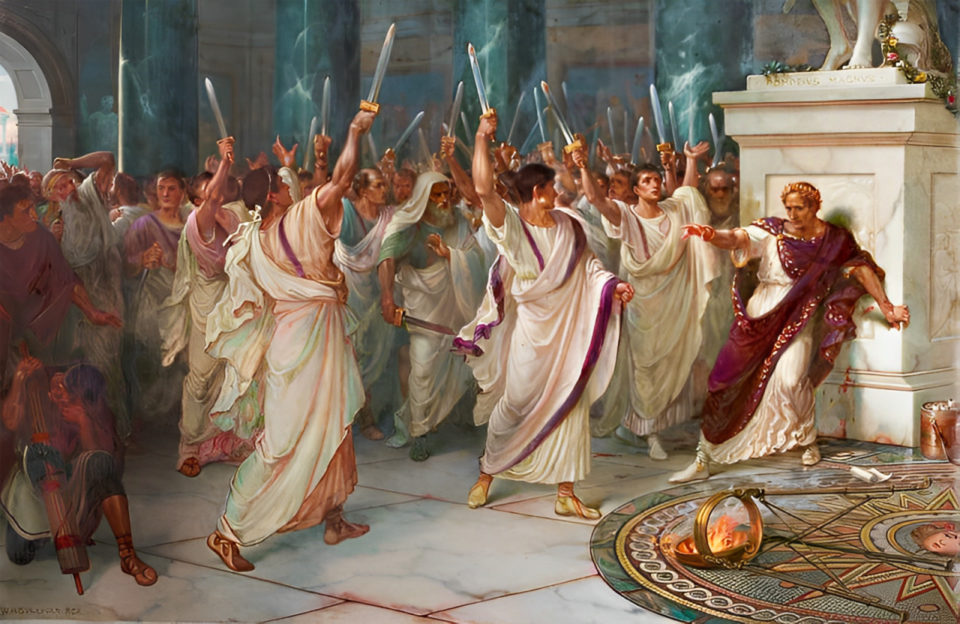
On the Ides of March in 44 BCE, Julius Caesar, the dictator of Rome, was assassinated by a group of senators who believed they were saving the Roman Republic. Led by Marcus Junius Brutus, Gaius Cassius Longinus, and other prominent figures, the conspirators hoped their actions would be celebrated as a defense of democracy. Instead, their fateful decision unleashed chaos and sealed their tragic destinies.
The Assassination and Its Immediate Repercussions
Caesar was ambushed and stabbed 23 times during a Senate meeting, with Brutus himself delivering one of the fatal blows. The conspirators declared the Republic free from tyranny, expecting public acclaim. However, their plans unraveled quickly.
The Roman people, many of whom admired Caesar for his reforms and generosity, reacted with outrage. Mark Antony, Caesar’s closest ally, skillfully turned public sentiment against the assassins through his stirring funeral speech, which highlighted Caesar’s will and his care for the common people. The resulting riots forced the conspirators to flee Rome, scattering across the provinces.
The Rise of the Second Triumvirate
In the power vacuum left by Caesar’s death, Mark Antony allied with Octavian (Caesar’s adopted heir) and Lepidus to form the Second Triumvirate. Together, they sought vengeance for Caesar, declaring the assassins enemies of the state.
The Triumvirate launched a campaign of proscriptions, targeting the conspirators and their supporters. This brutal purge confiscated property and executed many who had sided with the assassins.
The Fates of the Assassins
Marcus Junius Brutus and Gaius Cassius Longinus
Brutus and Cassius fled to the eastern provinces, raising an army to resist the Triumvirate. In 42 BCE, their forces faced Antony and Octavian at the Battle of Philippi.
Cassius: Believing the battle was lost after his forces suffered a defeat, Cassius took his own life, ordering a servant to kill him with a sword.
Brutus: Initially victorious, Brutus’s troops eventually succumbed to the enemy. Refusing to be captured, he committed suicide, declaring his defeat a result of Caesar’s lingering power: “O Julius Caesar, thou art mighty yet!”
Decimus Junius Brutus Albinus
Decimus, one of Caesar’s trusted commanders turned assassin, fled to Gaul. Betrayed by his soldiers, he was captured and executed by forces loyal to Antony in 43 BCE.
Gaius Trebonius
Trebonius, a participant in the assassination, was captured and killed by a loyalist of Mark Antony while in Asia Minor.
Other Conspirators
Many of the lesser-known conspirators met similar fates. Some were hunted down and executed, while others faded into obscurity, living in exile or dying in poverty. The Triumvirate’s relentless pursuit left few unscathed.
Conclusion
The assassins of Julius Caesar envisioned themselves as liberators of the Republic, but their actions had the opposite effect. Their failure to anticipate the power vacuum and the loyalty Caesar inspired among the people and his allies doomed their cause.
Rather than restoring the Republic, the assassination accelerated its transformation into an empire. Octavian’s rise as Augustus marked the end of the Roman Republic and the dawn of imperial rule.
The fate of Caesar’s assassins is a cautionary tale of unintended consequences. Their belief in violent means to achieve political ends led to personal ruin and the very outcome they sought to prevent. History remembers them not as saviors but as tragic figures, overwhelmed by the forces they unleashed.
