
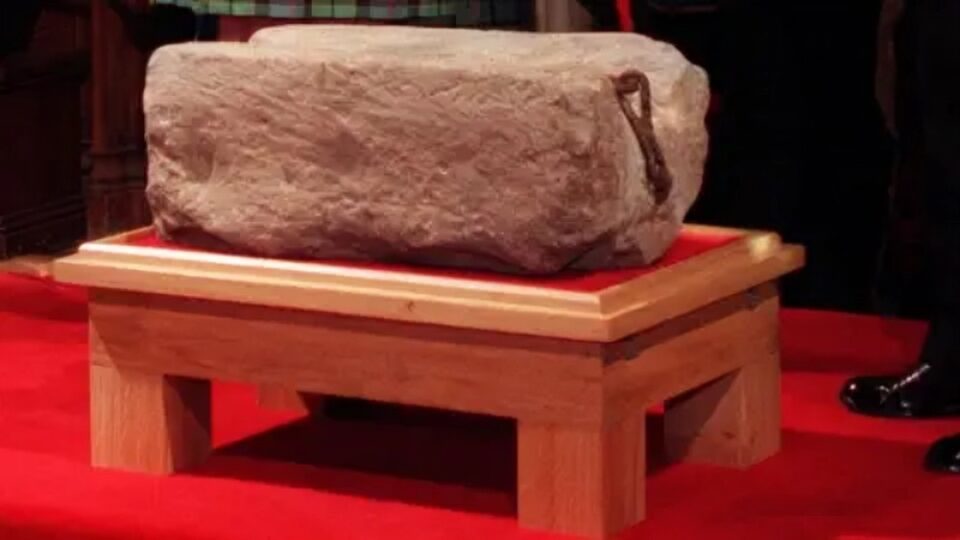
Few objects carry as much legend, politics, and symbolic weight as Scotland’s Stone of Destiny—also known as the Stone of Scone. To some, it is simply a block of sandstone. To the Scots, however, it represents sovereignty, kingship, and a centuries-long struggle for national identity. And in one of the most daring and symbolic acts of the 20th century, this stone was stolen—not by invading armies, but by Scottish students with a mission.
The Legend of the Stone
The Stone of Destiny is said to have been used in the coronation of Scottish kings for centuries, housed at the monastery of Scone Abbey near Perth. According to legend, it traces its origins back to biblical times—Jacob’s Pillow from the Old Testament, carried through Ireland before finally reaching Scotland.
Wherever the stone truly came from, its importance was undeniable: to be crowned upon it was to be recognized as Scotland’s rightful ruler.
Edward I and the First Theft
The Stone’s troubled history began in 1296, when King Edward I of England invaded Scotland. He seized the Stone of Destiny as spoils of war and had it transported to Westminster Abbey in London. There, it was placed beneath the Coronation Chair, so that every English—and later British—monarch would be crowned upon Scotland’s captured symbol.
For centuries, the stone sat in Westminster Abbey. To Scots, it remained a painful reminder of subjugation.
A Daring Student Heist
On Christmas Day, 1950, four Scottish students—Ian Hamilton, Kay Matheson, Gavin Vernon, and Alan Stuart—set out on an audacious mission: to steal the Stone of Destiny from Westminster Abbey and return it to Scotland.
Slipping into the Abbey under cover of night, they wrestled the massive 336-pound block out of the Coronation Chair. In the process, the stone actually broke in two, forcing them to smuggle the pieces out separately in cars.
When the theft was discovered, it made headlines across Britain. Police launched a nationwide hunt, but the students managed to evade capture long enough to return the repaired stone to Scotland. It was eventually left at Arbroath Abbey, a site of historic Scottish independence.
Political Shockwaves
The daring act electrified Scotland. Many saw it as a powerful symbol of defiance and a demand for national recognition. While the students were eventually caught, they were never prosecuted—likely because the British government feared making them martyrs for the Scottish nationalist cause.
The Stone was returned to Westminster Abbey, but the heist had reignited Scotland’s passion for self-determination.
The Stone Comes Home
In 1996, after centuries in England, the British government finally returned the Stone of Destiny to Scotland, where it now resides in Edinburgh Castle—next to the Scottish Crown Jewels. However, it was agreed that the stone would be sent back to London for future coronations, ensuring its continued role in British tradition.
Conclusion
The saga of the Stone of Destiny is about far more than sandstone. It is about power, identity, and the lengths people will go to reclaim symbols of sovereignty. The students who “stole” it in 1950 didn’t just move a rock; they shook an empire’s confidence and reignited a nation’s pride.
To this day, the Stone remains a reminder of Scotland’s enduring spirit—proof that sometimes, symbols matter as much as swords.
Do you want me to expand this into a dramatic storytelling version (like narrating the heist scene step by step, almost like a historical thriller), or keep it in this factual historical style?
