
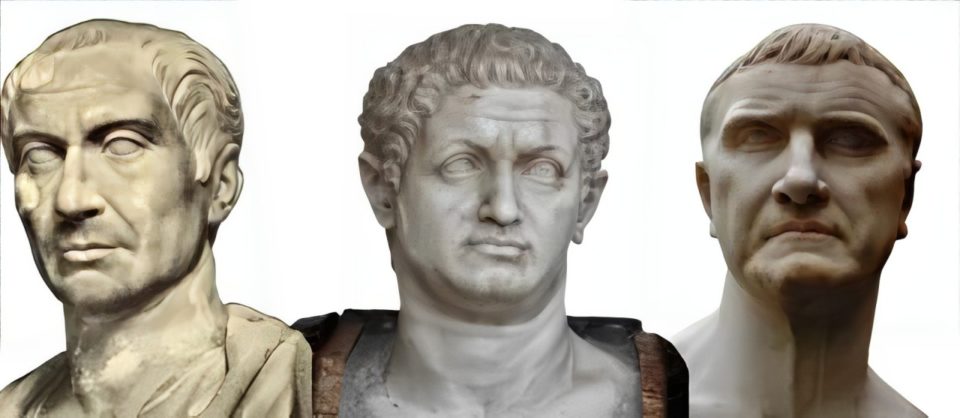
Julius Caesar and Gnaeus Pompey were two of the most influential figures of ancient Rome. They began as allies, working together to advance their political ambitions, but their partnership eventually devolved into one of the most famous rivalries in Roman history. The causes of their rivalry are rooted in ambition, shifting loyalties, and the competitive nature of Roman politics. Let’s explore the key factors that turned these allies into enemies.
The Formation of the First Triumvirate
In 60 BCE, Caesar, Pompey, and Marcus Licinius Crassus formed an informal alliance known as the First Triumvirate. This alliance allowed them to pool their political resources, advance mutual interests, and bypass the Roman Senate’s authority. Caesar gained the consulship and military command in Gaul, Pompey secured land settlements for his veterans, and Crassus, the wealthiest man in Rome, sought military prestige.
However, their alliance was always tenuous. It was held together not by friendship but by mutual convenience, and tensions began to surface as their individual ambitions grew.
Pompey’s Jealousy of Caesar’s Military Success
One of the key turning points in their relationship was Caesar’s increasing popularity and success during his campaigns in Gaul. Between 58 and 50 BCE, Caesar expanded Roman territory through his conquests, amassing wealth and winning the loyalty of his soldiers. His achievements outshone those of Pompey, who had previously been Rome’s greatest general.
As Caesar’s reputation soared, Pompey’s influence began to wane. He grew envious and concerned that Caesar’s popularity could threaten his position in Rome. In the competitive environment of Roman politics, where power and prestige were paramount, this jealousy laid the groundwork for their rivalry.
The Death of Crassus and the Collapse of the Triumvirate
Crassus’ death in 53 BCE during a failed campaign against the Parthians marked the end of the First Triumvirate. Without Crassus to mediate between Caesar and Pompey, their alliance unraveled. The balance of power between them was disrupted, and Rome became divided between those who supported Caesar and those who backed Pompey.
Political Tensions in Rome
In the years following Crassus’ death, the political climate in Rome became increasingly volatile. The Senate, alarmed by Caesar’s growing influence, began to align with Pompey. They saw him as a more controllable figure who could counterbalance Caesar’s power.
In 50 BCE, the Senate order Caesar to disband his army and return to Rome as a private citizen, fearing he might use his military power to seize control. Caesar, however, saw this as a direct threat to his political career and personal safety. He knew that returning to Rome without the protection of his army could result in his arrest or worse.
The Final Break: Crossing the Rubicon
The rivalry between Caesar and Pompey came to a head in 49 BCE. Faced with the Senate’s ultimatum, Caesar made a fateful decision: he crossed the Rubicon River with his army, a declaration of war against the Roman state. “Alea iacta est” (The die is cast), Caesar reportedly said, marking the point of no return.
Pompey, who had been given control of Rome’s forces, fled to Greece to raise an army, setting the stage for a civil war between the two former allies.
Conclusion
The rivalry between Caesar and Pompey was fueled by ambition, jealousy, and the fragile nature of political alliances in ancient Rome. What began as a partnership of convenience transformed into a bitter struggle for power, ultimately leading to civil war. Pompey’s defeat at the Battle of Pharsalus in 48 BCE marked the end of their rivalry, but it also signaled the downfall of the Roman Republic and the rise of Caesar’s dictatorship.
Their story serves as a timeless reminder of how ambition and competition can unravel even the most powerful alliances—and reshape history in the process.
