
The Roman Empire, at its height, was one of the most formidable military powers the world had ever seen. From the British Isles to North Africa and from Spain to the Middle East, Rome’s legions brought vast territories under their control. Yet, despite their successes, the Romans were never able to conquer Persia, a civilization that resisted their advances for centuries. The failure to subdue Persia was due to a combination of factors, including geography, military strategy, political instability, and the resilience of the Persian Empire.
Challenging Geography and Logistics
One of the primary reasons the Romans could not conquer Persia was the challenging geography that separated the two empires. Persia’s terrain, dominated by vast deserts, rugged mountains, and harsh climates, posed significant logistical challenges for Roman armies. Supplying and maintaining a large army deep within Persian territory was a daunting task. The long supply lines required to sustain Roman forces in the Persian heartland were vulnerable to disruption by Persian forces, who were well-acquainted with the local terrain and adept at using it to their advantage.
The Roman Empire, whose strength lay in its ability to project power across its vast and connected territories, found it difficult to maintain prolonged campaigns in the distant and inhospitable lands of Persia. The logistical difficulties, coupled with the harsh environment, made it nearly impossible for the Romans to establish and hold a permanent presence in the region.
Formidable Persian Military
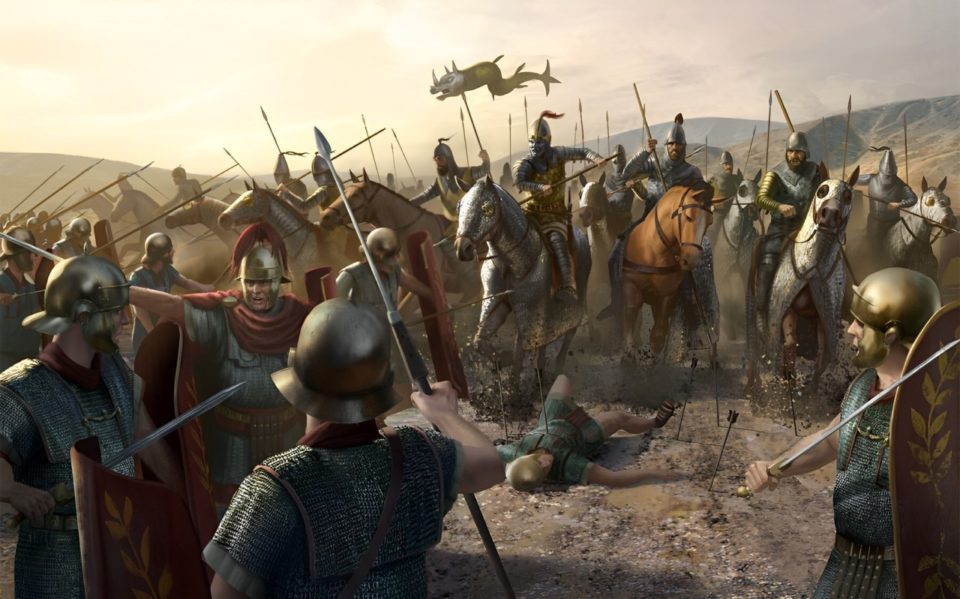
The Persian Empire, particularly during the Sasanian period (224–651 AD), developed a highly effective military system that was well-suited to counter Roman advances. The Persian army, known for its heavily armored cavalry, or cataphracts, was a formidable force on the battlefield. These cavalry units, combined with mobile horse archers, provided the Persians with a highly flexible and powerful military capability.
The Persians also employed sophisticated siege warfare techniques and had fortified cities that were difficult for the Romans to breach. Additionally, Persian rulers like Shapur I and Khosrow I were adept military leaders who could outmaneuver Roman forces and employ tactics that capitalized on their knowledge of the terrain and their strengths in cavalry warfare.
The Persians were not only able to defend their territory effectively but also to launch counterattacks into Roman-held lands, forcing the Romans to divert resources and attention away from offensive campaigns.
Roman Political and Military Instability
The Roman Empire’s internal challenges also played a significant role in its inability to conquer Persia. Throughout much of the period when the Romans were engaged in conflicts with Persia, the empire was plagued by political instability, including civil wars, assassinations, and power struggles. This internal discord weakened the Roman state and often left its military stretched thin, unable to focus all its resources on the Persian front.
Furthermore, the Roman Empire was frequently engaged in multiple wars on different fronts, from defending the Rhine and Danube borders against Germanic tribes to maintaining control over its provinces in North Africa and the Middle East. This constant state of military engagement meant that the empire could rarely concentrate the full might of its legions against Persia.
Even during the periods when the Romans did attempt major campaigns against Persia, such as under Emperor Julian’s ill-fated expedition in 363 AD, the efforts were hampered by insufficient preparation, underestimation of the enemy, and the persistent threat of political upheaval at home.
The Resilience and Strategic Adaptability of the Persian Empire
The Persian Empire, throughout its various dynasties, was known for its resilience and ability to adapt to changing circumstances. The Persians were skilled in diplomacy as well as warfare, often forming alliances with Rome’s enemies to counterbalance Roman power. They also engaged in political and cultural strategies that helped to unify their diverse empire against external threats.
The Sasanian rulers, in particular, were highly focused on strengthening their empire’s infrastructure, economy, and military capabilities, ensuring that Persia could withstand prolonged conflicts with Rome. The Persian Empire’s ability to maintain its cohesion and counter Roman aggression over centuries speaks to its strategic depth and the effectiveness of its leadership.
Strategic Parity and Mutual Exhaustion
Over time, the conflicts between Rome and Persia evolved into a kind of strategic parity, where neither side could achieve a decisive victory over the other. This balance of power led to a series of conflicts that, while destructive, ultimately did not result in the conquest of one empire by the other.
The Roman and Persian empires were both vast and resource-rich, but they were also evenly matched in terms of military capabilities and strategic depth. This parity meant that even after significant victories, neither side could fully capitalize on them to achieve lasting domination. Instead, the two empires often settled for negotiated peace treaties, recognizing that prolonged warfare would only lead to mutual exhaustion.
Conclusion
The Roman Empire’s inability to conquer Persia was the result of a complex interplay of factors, including the challenging geography, the formidable Persian military, internal instability within Rome, and the resilience and adaptability of the Persian Empire. Despite their many attempts, the Romans could never fully overcome these obstacles, and Persia remained a powerful and independent rival on the empire’s eastern frontier.
In the end, the Roman-Persian conflicts highlight the limits of even the most powerful empires and the enduring strength of a well-defended and strategically savvy civilization. Persia’s resistance to Roman conquest stands as a testament to the difficulties of imperial expansion and the importance of understanding the unique challenges posed by different regions and opponents.
