
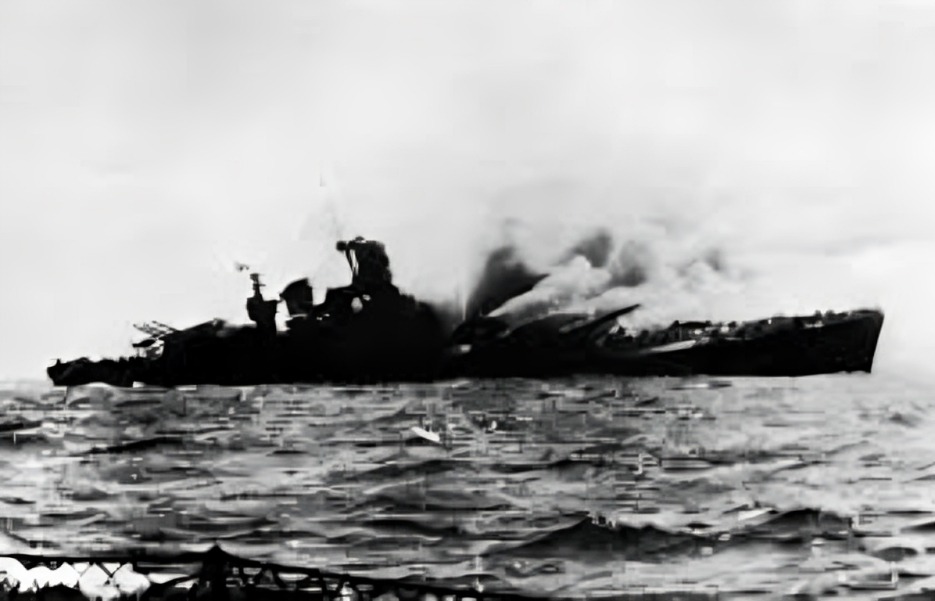
The story of the Italian battleship Roma is one of both tragedy and historical significance. Launched with pride during World War II, she was the most advanced battleship of the Italian Navy, yet her fate was sealed not by a grand naval battle, but by a new kind of weapon that changed warfare forever. The sinking of Roma in September 1943 was not only a devastating loss for Italy but also a turning point that revealed the deadly effectiveness of precision-guided bombs.
A Ship Built for Power and Prestige
The Roma was the third and final ship of the Littorio-class battleships, a group designed in response to France’s powerful naval expansion in the 1930s. She was launched in June 1940 from the shipyards of Trieste, but due to delays caused by the war, she was not fully operational until June 1942.
With a displacement of nearly 45,000 tons and a length of 240 meters, Roma was a formidable vessel. She carried nine massive 381 mm (15-inch) guns, heavy armor, and state-of-the-art fire-control systems. Her speed exceeded 30 knots, making her one of the fastest battleships of her era. To the Italians, she represented naval pride, technological sophistication, and the hope of challenging the Royal Navy in the Mediterranean.
Limited Action in the Mediterranean
Despite her impressive design, Roma never had the chance to showcase her full power. By the time she entered service, Italy’s naval situation had become desperate. Fuel shortages restricted fleet operations, while the Allies’ growing dominance in the air and at sea limited opportunities for major engagements.
During her short career, Roma escorted convoys and participated in missions, but she never engaged in a decisive battle against the enemy. The ship’s most significant role came only after Italy signed the Armistice of Cassibile with the Allies in September 1943.
The Armistice and a New Mission
On 8 September 1943, Italy announced its surrender to the Allies. This sudden political shift left the Italian Navy in a precarious position. To prevent their powerful fleet from falling into German hands, the Italian command ordered its warships, including Roma, to sail south and join the Allies.
On 9 September, Admiral Carlo Bergamini led a fleet of battleships, cruisers, and destroyers out of La Spezia. The fleet, with Roma as the flagship, was bound for Malta to formally surrender.
But the Germans had anticipated this move. Hitler ordered the fleet destroyed before it could be delivered to the Allies. What followed was a demonstration of a terrifying new weapon.
The Attack by the Luftwaffe
As the Italian fleet sailed near Sardinia, it was spotted by German aircraft from Kampfgeschwader 100. These planes carried the Fritz X, an experimental radio-guided glide bomb developed by the Luftwaffe. It was the first precision-guided weapon ever used against a battleship.
At approximately 15:30 on 9 September 1943, German Dornier Do 217 bombers attacked. The Italian fleet had little air cover and no effective means to counter this new weapon.
- The first Fritz X hit Roma near the forward engine rooms, causing massive flooding and reducing her speed.
- The second struck near the aft magazines, igniting a catastrophic explosion.
Eyewitnesses recalled that the blast tore open the battleship’s hull and lifted the 1,500-ton turret into the air. Within minutes, Roma was mortally wounded. She listed heavily to port, broke apart, and sank at around 16:15, taking with her 1,393 men, including Admiral Bergamini.
Significance of the Sinking
The sinking of Roma was significant for several reasons:
The First Guided Weapon Success
The Fritz X attack marked the first time a precision-guided bomb had successfully sunk a battleship. It signaled the end of the battleship era and the beginning of modern guided warfare.
A Blow to Italian Morale
Italy had just signed an armistice to end hostilities, and yet one of its greatest warships was destroyed by its former ally, Germany. The loss of life and prestige deepened Italy’s turmoil during its political and military transition.
The End of Battleship Dominance
Though battleships had long symbolized naval power, the attack on Roma proved that airpower and advanced weapons could render even the largest warships vulnerable. The lessons learned would influence naval strategy for decades.
Remembering the Roma
For many years, the wreck of Roma remained hidden beneath the Mediterranean waves. In 2012, Italian authorities confirmed the discovery of the wreck at a depth of around 1,000 meters off the coast of Sardinia. The find renewed interest in her story and gave closure to the families of the sailors who perished.
Today, Roma is remembered not only as a marvel of naval engineering but also as a symbol of sacrifice and the devastating human cost of war. Memorials in Italy honor Admiral Bergamini and the crew who went down with their ship.
Conclusion
The sinking of the battleship Roma is one of the most tragic episodes in naval history. A ship built to represent Italian pride and power ended up destroyed not in a grand sea battle, but by a revolutionary weapon that changed naval warfare forever.
Her story is a reminder of the swift pace of technological change in wartime and the thousands of lives caught in the crossfire of political and military upheaval. The Roma may rest at the bottom of the sea, but her legacy endures—as both a testament to naval ambition and a solemn warning of war’s destructive power.
Would you like me to also create a timeline infographic of Roma’s history (from her launch to her sinking) so the article feels even richer and easier to follow
