
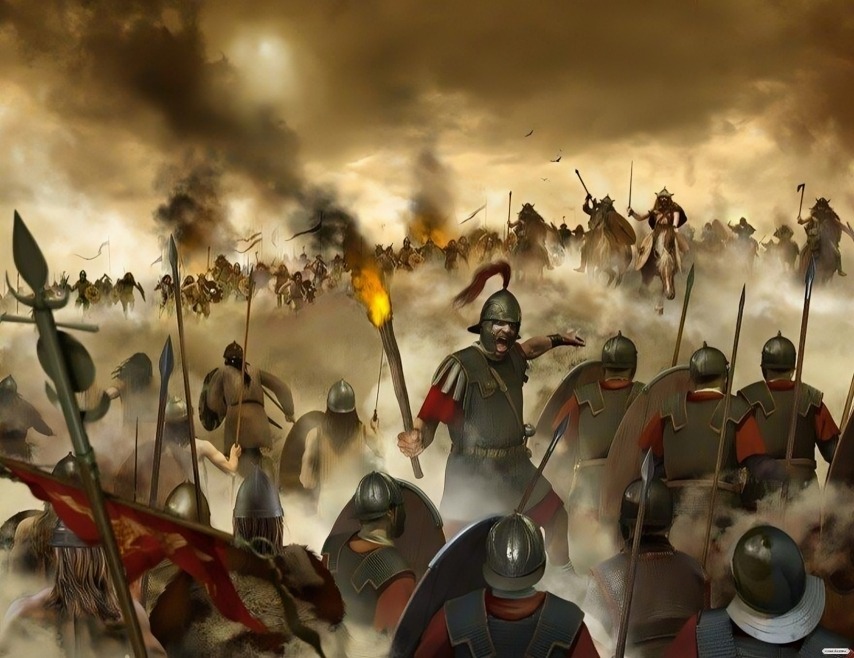
For over a thousand years, the Roman Empire dominated the ancient world with unmatched military might. From Caesar’s conquests to the legions guarding the far corners of Europe, Rome built its legacy through war, discipline, and expansion. But all empires must fall—and when they do, it’s often not with a whisper, but with one final clash that marks the end of an age.
That clash came at the Battle of Adrianople in 378 CE—a brutal, bloody engagement that historians now recognize as the last grand battle of the united Roman Empire. It was the beginning of the end.
Here’s how it happened, what led to it, and why it changed Rome forever.
The Eastern Empire Faces a Crisis
By the late 4th century CE, the Roman Empire was divided into eastern and western halves, each ruled by its own emperor. In the East, Emperor Valens ruled from Constantinople, while in the West, his nephew Gratian governed from Gaul.
The empire had been stretched thin by internal strife, weak leadership, and rising threats along the frontiers. But the most pressing danger came from a massive migration of Gothic tribes, fleeing westward after being displaced by the ruthless Huns from the steppes of Central Asia.
A Deal Gone Wrong
In 376 CE, Valens made a decision that would haunt him: he allowed thousands of Gothic refugees to cross the Danube River and settle within Roman territory—on the promise that they would lay down arms and be peacefully integrated.
But poor planning, corruption, and mistreatment turned the Goths against Rome. They were starved, abused, and denied land. Instead of becoming allies, the Goths rose in rebellion.
By 378, tensions boiled over into full-blown war.
The Battle of Adrianople Begins
On August 9, 378 CE, the Roman army met the Gothic forces near the city of Adrianople (modern-day Edirne, Turkey). Emperor Valens, eager for glory and underestimating the enemy, refused to wait for reinforcements from the Western Empire.
He believed the Gothic army was disorganized and could be easily crushed.
He was wrong.
A Devastating Defeat
The Roman army, possibly 20,000 strong, launched its attack. But it quickly fell apart. The Goths had lured the Romans in with a partial force—the rest of the Gothic cavalry was hidden and waiting.
When the trap was sprung, the Roman legions were surrounded and slaughtered. It became one of the most devastating defeats in Roman history.
Emperor Valens himself was killed, likely burned alive in a farmhouse where he had taken shelter. His body was never found.
Why Adrianople Was a Turning Point
The Battle of Adrianople shattered the myth of Roman invincibility. It proved that barbarian tribes could not only challenge Rome—but defeat it in open battle. More importantly, it exposed how fragile the empire had become.
- The Eastern army was crippled.
- The Gothic threat deepened, leading to more incursions.
- The Roman military would never fully recover.
- Rome began to rely heavily on foreign mercenaries, many of whom had no real loyalty to the empire.
Although the Western Empire would limp on until 476 CE, and the Eastern (Byzantine) Empire would survive for another thousand years, Adrianople marked the beginning of the empire’s irreversible decline.
Conclusion
The Battle of Adrianople wasn’t just another Roman defeat—it was a signal flare marking the end of an era. The Roman Empire had fought countless battles over the centuries, but this was the last one where the full might of a Roman field army stood against an enemy in classic formation—and lost decisively.
In its aftermath, the Rome that had ruled the world began to crumble, not with one collapse, but with a slow unraveling.
The empire survived in name. But the days of Roman dominance, Roman glory, and Roman certainty—those died on the fields of Adrianople.
