
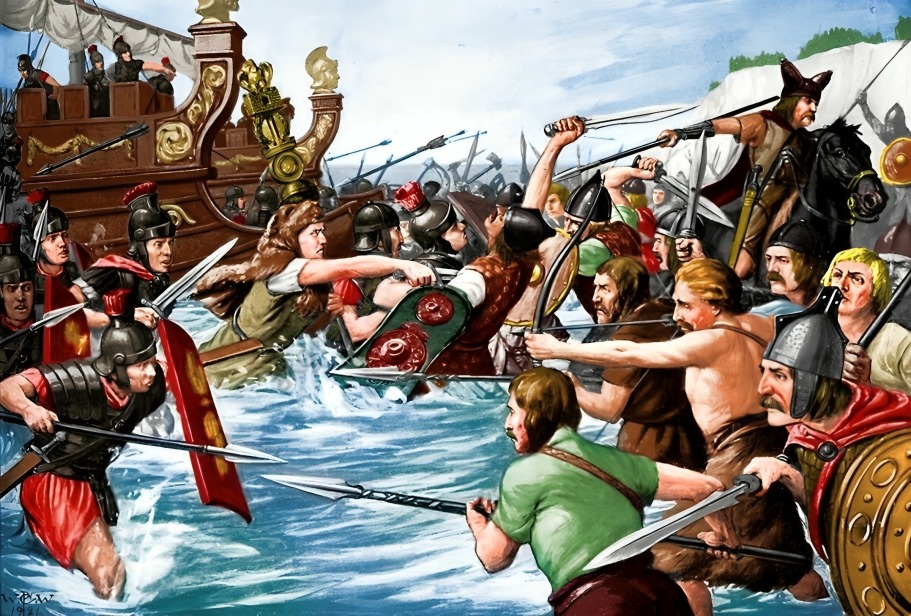
The Roman conquest of Britain is often framed as a carefully orchestrated act of imperial expansion—a deliberate move by Emperor Claudius to secure political glory and expand the empire’s reach. But history, as it often does, hides surprising twists behind its grand narratives. In fact, one of the most pivotal moments in Rome’s march to Britannia came not from planning, but from an unexpected coincidence—one that changed the course of British history forever.
Let’s unravel how a mix of timing, weather, and political luck helped the Romans land on British soil.
Setting the Stage: Why Rome Wanted Britain
By the 1st century AD, the Roman Empire had spread across most of Western Europe, from Spain to the Rhine. Britain remained just beyond the empire’s grip—a mysterious, wealthy island known for its tin, grain, and restless tribes.
Julius Caesar had launched two exploratory invasions of Britain in 55 and 54 BC, but he never established a lasting Roman presence. Nearly a century later, Emperor Claudius needed a military victory to strengthen his shaky political position in Rome. Britain was the perfect target: exotic, close, and symbolically powerful.
The Problem: The Channel Crossing
Rome’s armies were mighty on land, but crossing the English Channel was no small feat. The sea was unpredictable, the weather treacherous, and the enemy foreign. In 43 AD, General Aulus Plautius led a large Roman force across the Channel—but the crossing didn’t go smoothly.
The fleet became scattered in the water. Unfamiliar with local tides and harbors, many Roman ships landed in the wrong places or were delayed by stormy weather.
But here’s where fate intervened.
The Coincidence That Changed Everything
As Roman soldiers scrambled to regroup along the southern coast of Britain, something unusual happened: many of the British tribes thought the invasion was a false alarm. Why? Because the Roman fleet had arrived slowly and sporadically, not as a full, united force.
Some British leaders, believing the Romans were struggling or had even given up, lowered their defenses. Others were caught off guard entirely.
This moment of confusion allowed Roman units to land with minimal resistance in several key locations. As more of the Roman army arrived, the beachhead grew stronger. What could have been a disastrous, chaotic landing turned into a successful foothold on British soil.
In other words, the Romans didn’t outfight the Britons—they outlucked them, at least in the beginning.
Claudius’ Showstopper Moment
Once the beachhead was secure, Emperor Claudius himself sailed to Britain with elephants and a display of military spectacle, arriving after most of the fighting had already been won. His presence sealed the psychological victory and allowed him to claim credit for the conquest.
But without that initial accidental advantage—the scattered fleet and the false sense of security it gave the Britons—the Roman invasion could have turned into a bloody stalemate or outright failure.
What Followed: From Coincidence to Conquest
The Romans quickly established control over southeastern Britain, founding Londinium (modern London) and pushing inland. The invasion led to nearly four centuries of Roman rule in Britain, deeply shaping the island’s language, architecture, roads, and politics.
And yet, it all might have failed—if not for a lucky misstep and a moment of hesitation on the part of the British tribes.
Conclusion
The Roman conquest of Britain is often remembered as inevitable, but it wasn’t. Like many major events in history, it turned on a quiet coincidence—an accidental advantage created by nature, miscommunication, and assumption.
It’s a powerful reminder that behind every empire lies not just strategy and strength—but also luck.
