
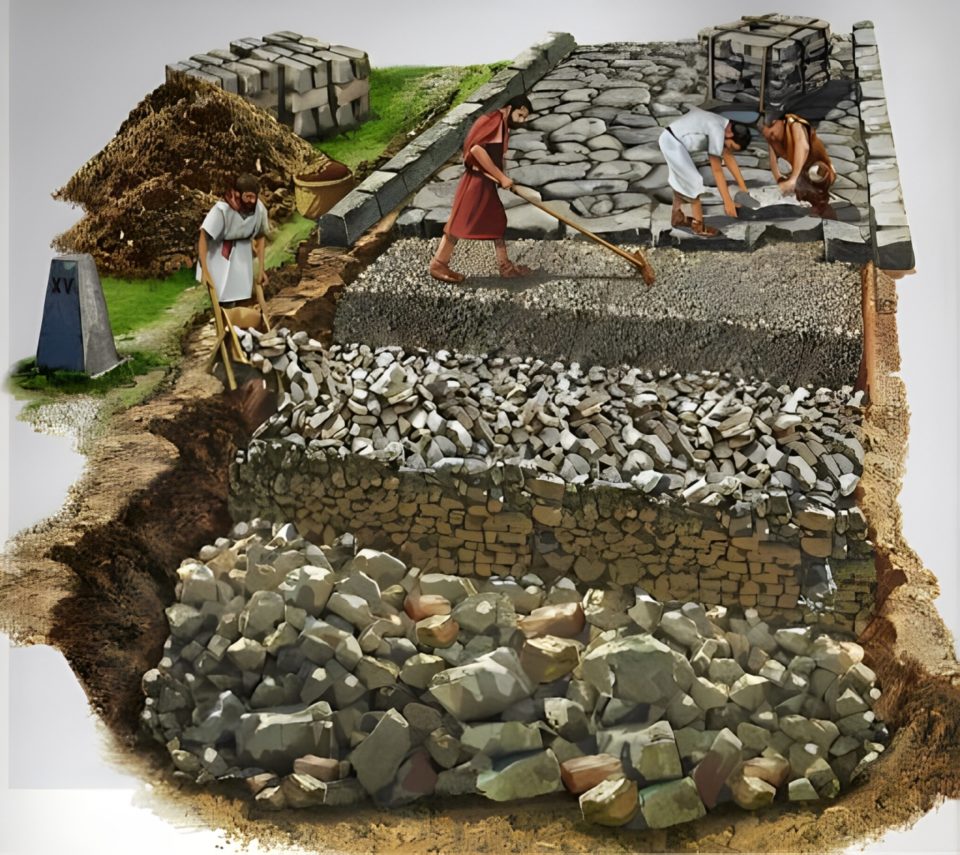
The vast and mighty Roman Empire owed much of its success to its incredible network of roads, which facilitated trade, military movement, and administration. These roads, built over two millennia ago, remain a testament to Roman engineering prowess. Constructed with durability and efficiency in mind, Roman roads connected distant provinces, enabling swift movement across the empire. But how exactly were these roads built?
Planning and Surveying
Before construction began, Roman engineers, known as agrimensores, meticulously planned the road’s path. Using simple but effective tools like the groma (a surveying instrument) and chorobates (a leveling tool), they determined the most direct and efficient routes, often choosing straight paths whenever possible. The Romans were skilled in adapting to geographical challenges, such as hills, rivers, and marshes, by incorporating bridges, tunnels, and causeways.
The Construction Process
Once the route was determined, construction began in several structured layers:
Excavation and Foundation
The first step was to dig a trench along the planned route, sometimes up to three feet deep, to create a solid foundation. If the ground was soft or unstable, additional reinforcement such as wooden pilings was used.
Layering the Roadbed
The road was built in multiple layers to provide strength and durability. These layers typically included:
Statumen: The bottom layer, made of large stones or rubble, provided stability and drainage.
Rudus: A middle layer of smaller stones or gravel, compacted for additional support.
Nucleus: A finer layer of sand, crushed stone, and mortar, acting as a binder.
Summum Dorsum: The top layer, often paved with large, interlocking stone slabs (such as basalt), designed to withstand heavy use and weathering.
Drainage and Curvature
Proper drainage was a crucial aspect of Roman road construction. Roads were slightly convex (a technique known as cambering) to allow rainwater to run off into ditches on either side, preventing erosion and puddles.
Finishing Touches
Roman roads often included additional elements for functionality and aesthetics, such as:
Milestones: Placed at regular intervals, these provided travelers with distance markers and information about nearby destinations.
Rest Stops (Mansiones and Mutatio): Roadside stations were built for travelers and messengers to rest, change horses, or seek shelter.
Bridges and Tunnels: Where necessary, bridges made of stone or wood and tunnels carved through rock ensured the road maintained its straight path.
The Role of the Army in Road Building
While skilled laborers and engineers oversaw the projects, the Roman legions played a significant role in road construction, especially in newly conquered territories. Building roads allowed for faster troop movements, securing control over new regions. Soldiers performed much of the manual labor, ensuring roads were built quickly and efficiently.
Longevity and Legacy
Roman roads were remarkably durable, with many still visible and in use today. Their superior construction set the standard for road-building techniques throughout history, influencing modern infrastructure. Many European highways still follow the paths of ancient Roman roads.
Conclusion
The construction of Roman roads was a remarkable achievement that showcased the empire’s engineering ingenuity and strategic planning. These roads not only enabled economic prosperity and military dominance but also helped unify a vast and diverse empire. The legacy of Roman roads continues to shape modern transportation networks, proving that their construction was truly ahead of its time.
