
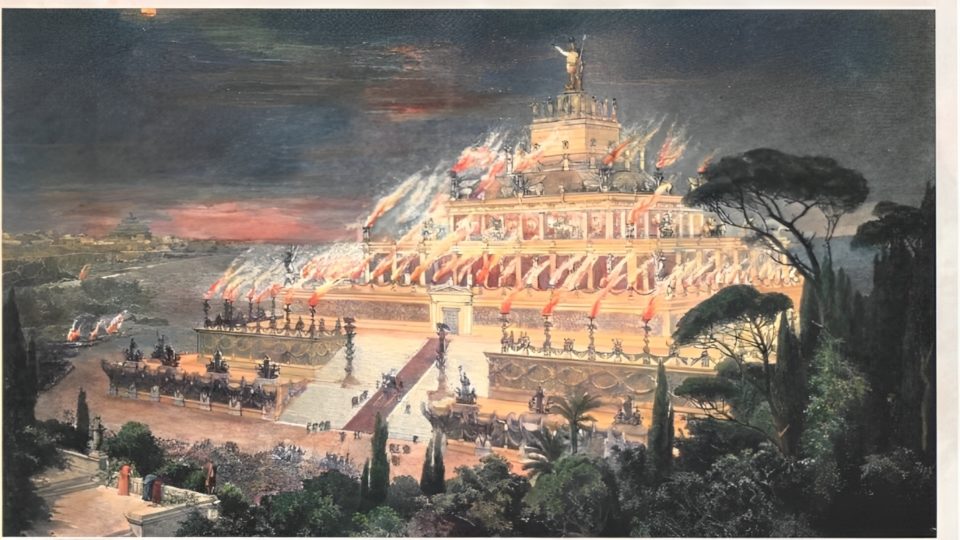
Hephaestion, the closest companion and most trusted general of Alexander the Great, was more than just a military leader. He was Alexander’s childhood friend, confidant, and possibly even his lover. His untimely death in 324 BCE devastated Alexander, leading to one of the grandest funerary honors of the ancient world. The way Hephaestion was laid to rest reflected not only Alexander’s profound grief but also the extraordinary status Hephaestion held in his life and empire.
Hephaestion: More Than a Friend
Hephaestion was an integral figure in Alexander’s life from an early age. Raised alongside Alexander in the court of Philip II of Macedon, he was educated by Aristotle and trained in warfare, diplomacy, and leadership. The two young men developed a deep bond that would last throughout their lives.
Often compared to the legendary duo Achilles and Patroclus, Hephaestion and Alexander shared a relationship built on mutual trust, ambition, and unwavering loyalty. Hephaestion was one of the few people Alexander could rely on entirely, making him indispensable in both military and political matters. As a general, he played a crucial role in Alexander’s campaigns, helping to secure victories across Persia and beyond. His death at Ecbatana, likely from typhoid or another fever, left Alexander inconsolable.
Alexander’s Devastation and Mourning
The news of Hephaestion’s passing struck Alexander with unbearable grief. Ancient sources describe how Alexander refused to eat or drink for days, isolating himself in mourning. In an act reminiscent of Achilles mourning Patroclus, Alexander cut his hair, refused to bathe, and openly wept for his fallen companion. His sorrow quickly turned into an obsession to immortalize Hephaestion’s memory in the most extravagant way possible.
To honor Hephaestion, Alexander adopted a series of extreme mourning rituals, including:
Executing Hephaestion’s physician: Alexander held Hephaestion’s doctor accountable for his death and had him executed for failing to save his closest friend.
Sacrificing to gods on Hephaestion’s behalf: Hephaestion was given divine honors, and sacrifices were made to the gods in his name.
Ordering state-wide mourning: Alexander commanded that the entire empire mourn Hephaestion, ensuring that his grief was shared across his dominion.
The Grand Funeral Arrangements
Determined to give Hephaestion a funeral fit for a hero, Alexander planned a state funeral of unprecedented scale. Some key elements included:
A Monumental Pyre: In Babylon, Alexander commissioned a massive funeral pyre, estimated to be over 200 feet tall, adorned with sculptures, gold, and intricate designs. This was meant to showcase Hephaestion’s importance and immortalize his memory.
Heroic Honors: Alexander declared Hephaestion a divine hero, ordering cities to establish temples, festivals, and games in his honor. His image was placed among those of gods and legendary warriors.
Worldwide Mourning: Official decrees commanded mourning across the empire. Cities in Greece, Egypt, and Persia observed rituals and ceremonies to honor Hephaestion’s spirit.
Lavish Expenditures: The funeral reportedly cost 10,000 talents, an astronomical sum in the ancient world, equivalent to billions today, making it one of the most expensive funerary ceremonies in history.
The Legacy of Hephaestion’s Death
Alexander’s profound grief over Hephaestion’s death may have contributed to his own decline. Many historians believe he never recovered emotionally, and his health rapidly deteriorated in the months that followed. Less than a year later, in June 323 BCE, Alexander himself succumbed to illness, with some accounts suggesting that his death was partly due to his overwhelming sorrow.
Hephaestion’s legacy did not end with his funeral. Monuments, temples, and statues were erected in his honor, ensuring that his name would be remembered alongside Alexander’s. Even after Alexander’s empire fragmented following his death, Hephaestion’s name lived on in history as one of the few individuals who had the unwavering loyalty and love of the greatest conqueror the world had ever known.
Conclusion
Hephaestion’s funeral was more than a simple farewell; it was a declaration of Alexander’s undying devotion and a symbol of the grandeur of their shared dreams. His lavish burial, heroic honors, and the monumental efforts Alexander undertook to ensure his memory endured, showcased the immense depth of their bond. In death, Hephaestion received the same honors as the greatest heroes of myth, ensuring that his legacy, much like Alexander’s, would never be forgotten. Their story remains one of the most poignant examples of love, friendship, and loyalty in the annals of history.
