
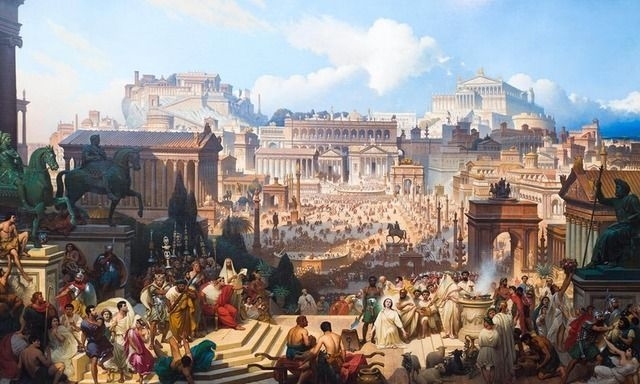
Ancient Rome is often celebrated as one of the most innovative and advanced civilizations in history. However, many of its famed achievements were not entirely original. Instead, the Romans were masters of adaptation, borrowing and refining ideas and technologies from the civilizations they encountered. Here are seven surprising examples of how Rome took innovations from others and made them their own.
Aqueducts: Inspired by Ancient Greece and the Etruscans
Rome is famous for its complex aqueduct systems that brought fresh water to cities. While the Romans perfected the use of arches and concrete in their construction, the idea of aqueducts came from the Greeks and the Etruscans. The Etruscans, who inhabited central Italy before the rise of Rome, developed early systems of water channels, which the Romans later expanded into monumental structures.
Concrete: A Blend of Etruscan and Greek Techniques
Roman concrete, or opus caementicium, was a game-changer in ancient architecture, allowing the construction of iconic structures like the Colosseum and the Pantheon. However, the Etruscans were already using basic forms of concrete. The Romans enhanced the formula by incorporating volcanic ash, which made their concrete more durable and water-resistant.
Road Systems: Modeled After Persian Innovations
Rome’s vast network of roads—stretching over 250,000 miles—was essential for the empire’s expansion and control. Yet, the concept of well-maintained roads was pioneered by the Persian Empire. The Persian Royal Road served as a blueprint for the Roman system, which the Romans improved by adding layers of gravel, sand, and stones for durability.
Military Formations: Adapted From the Greeks
The famed Roman legionary tactics weren’t entirely their invention. The Romans initially fought in a Greek-style phalanx formation but found it too rigid for Italy’s varied terrain. Over time, they adapted the phalanx into the more flexible manipular system, allowing for greater mobility and coordination during battles.
Public Baths: Borrowed From Hellenistic Culture
Rome’s luxurious public baths, or thermae, were a cornerstone of Roman social life. The tradition of public bathing, however, was introduced by the Greeks. The Romans expanded on this concept by creating larger complexes with heated floors, steam rooms, and swimming pools, turning bathhouses into architectural marvels.
Architecture: Greek Columns and Etruscan Arches
Roman architecture is a blend of Greek elegance and Etruscan engineering. The Romans borrowed the use of Doric, Ionic, and Corinthian columns from the Greeks and combined them with the Etruscan arch to create grand structures like aqueducts, amphitheaters, and temples. The Pantheon, for example, exemplifies this synthesis of styles.
The Roman Alphabet: Evolved From Etruscan and Greek Scripts
The Roman alphabet, the foundation of modern Western writing systems, wasn’t an original creation. It evolved from the Etruscan alphabet, which was itself derived from Greek scripts. The Romans adapted these letters to better suit Latin, creating the familiar alphabet we use today.
Conclusion
Ancient Rome’s greatness didn’t lie in inventing everything from scratch—it lay in its ability to assimilate, improve, and innovate on the ideas of others. By borrowing from the Greeks, Etruscans, Persians, and others, the Romans built an empire that not only lasted for centuries but also left an enduring legacy.
These examples remind us that even the mightiest civilizations stand on the shoulders of those who came before. In many ways, Rome’s success was a testament to its openness to learning and adapting from the world around it.
