
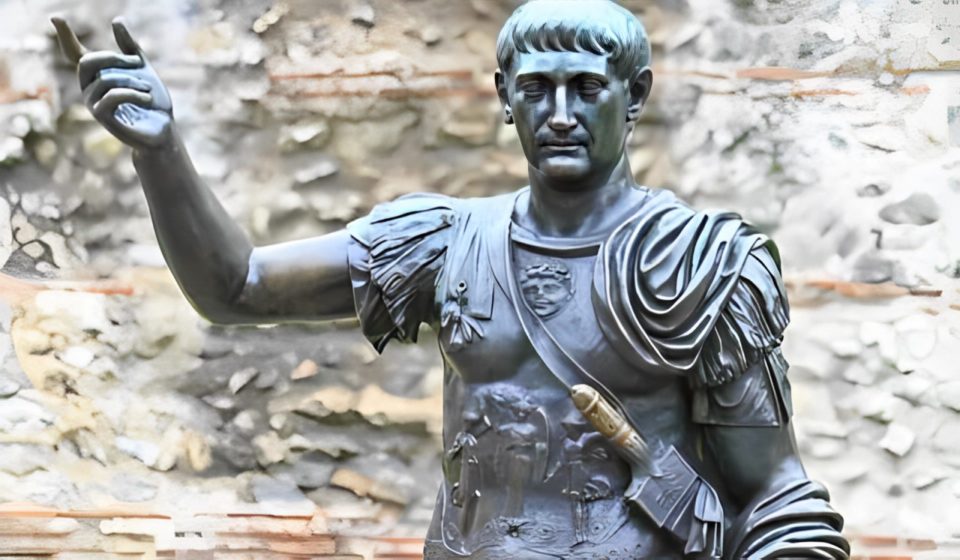
Emperor Trajan, who ruled from 98 to 117 AD, is celebrated as one of Rome’s most transformative leaders. Known for his military conquests, infrastructure improvements, and policies that supported the welfare of his people, Trajan’s reign marked the Roman Empire’s greatest territorial expansion and a period of prosperity and stability.
Territorial Expansion and Military Conquests
Trajan’s expansionist policies defined his legacy. He launched successful campaigns that pushed the empire’s boundaries to their greatest extent. One of his most notable conquests was the Dacian Wars, where Trajan subdued the kingdom of Dacia (modern-day Romania), acquiring vast resources, especially gold. This victory was not only a military success but also an economic boon, as it funded Trajan’s ambitious building projects and provided resources that supported the empire’s stability.
Following the conquest of Dacia, Trajan turned his focus to the East, engaging in campaigns against the Parthian Empire. His advances into Armenia, Mesopotamia, and parts of the Arabian Peninsula expanded Rome’s influence and secured valuable trade routes. However, these territories proved challenging to hold, and many were lost after his death. Nonetheless, Trajan’s military campaigns reinforced Rome’s dominance and brought wealth and cultural exchanges into the empire.
Public Works and Infrastructure Development
Trajan is renowned for his monumental building projects that transformed Rome’s urban landscape and improved the lives of its citizens. Perhaps his most famous project is Trajan’s Forum, a grand complex that included libraries, a marketplace, and the iconic Trajan’s Column, which celebrated his Dacian victories. Trajan’s Forum stood as a testament to Rome’s prosperity and was a center for public life and administration.
In addition to grand monuments, Trajan invested in infrastructure, particularly in roads, aqueducts, and ports. His improvements to road networks facilitated trade and military movement, reinforcing the empire’s connectivity. The construction of aqueducts and new water systems improved the public health and quality of life for the empire’s residents, particularly in cities where access to clean water was crucial.
Policies Supporting Welfare and the Economy
Trajan is also remembered for his progressive social policies. One of his most notable initiatives was the alimenta program, which provided financial support to poor children across Italy. The program aimed to improve child welfare and address the declining population by ensuring that impoverished families received the means to support their children. This initiative underscored Trajan’s commitment to the Roman people and highlighted his understanding that the empire’s future depended on a healthy, growing population.
Trajan’s reign also saw economic growth driven by his infrastructure investments and the influx of wealth from conquered territories. By reinvesting the empire’s wealth in public works and welfare programs, Trajan ensured that Rome’s prosperity was shared across society. His policies contributed to economic stability and maintained the loyalty of the provinces.
Legacy and Long-term Influence
Trajan’s legacy has endured as an example of effective and just leadership. Ancient historians, notably Cassius Dio and Pliny the Younger, praised Trajan for his fair governance and his ability to balance military ambition with civic responsibility. His reign became a model for later emperors, symbolizing a period when the empire flourished both territoriality and culturally.
Trajan’s military successes, public works, and social programs combined to create an era of stability and growth, often referred to as the apex of the Roman Empire. His leadership style, which emphasized the welfare of his people alongside military strength, set a standard that influenced subsequent emperors and contributed to the longevity of Roman influence.
Conclusion
Emperor Trajan’s reign brought the Roman Empire to its zenith, not just in terms of territorial size but also in prosperity, infrastructure, and public welfare. His balance of ambition with benevolence left a profound impact, making him one of Rome’s most revered emperors. Trajan’s legacy as a builder, conqueror, and compassionate leader offers a timeless example of how visionary leadership can transform a society for the better.
