
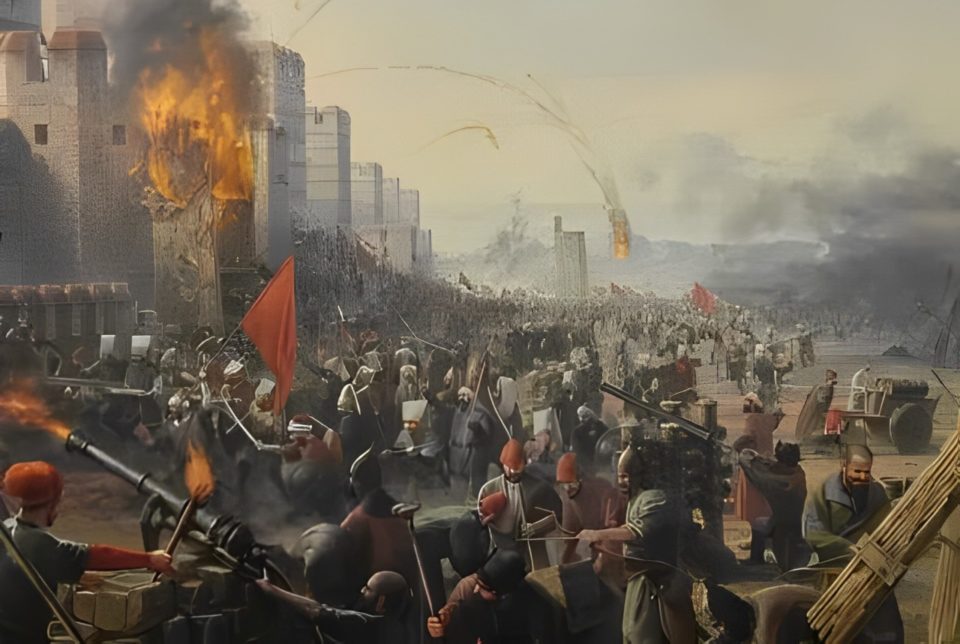
When Rome fell in 476 AD, the Western Roman Empire came to an end, leaving the Eastern Roman Empire, also known as the Byzantine Empire, as the last remnant of the once-mighty Roman civilization. Constantinople, the capital of the Byzantine Empire, viewed itself as the legitimate heir to the Roman legacy and continued to rule under the title of “Roman Emperor.” But did Constantinople ever attempt to retake Rome after the Western Empire fell? The answer lies in a mix of political strategy, military ambition, and a complex series of historical events that reveal how the Byzantines attempted—and ultimately struggled—to reclaim Rome and its former territories.
The Ambitious Goals of Emperor Justinian I
The most notable attempt to retake Rome occurred under the reign of Emperor Justinian I, who ruled from 527 to 565 AD. Justinian had a grand vision of restoring the full Roman Empire under his rule. He believed that reuniting Rome under the Byzantine banner would not only reclaim lost territory but also strengthen the empire’s cultural and religious identity. This ambitious campaign to recover the Western Empire, often called the “Justinian Reconquest” or “Byzantine Reconquest,” was his most significant undertaking.
To accomplish this, Justinian relied heavily on his famous general, Flavius Belisarius, who led a series of military campaigns across the former Western Roman territories.
The Gothic War and the Struggle for Italy
In 535 AD, Justinian launched the Gothic War, a campaign aimed at reclaiming Italy and, most notably, Rome itself, which was then under the control of the Ostrogoths. Initially, the Byzantines achieved rapid success. Belisarius and his forces captured Sicily, and in 536 AD, they entered Rome, marking the first time Rome had been under Roman rule since the fall of the Western Empire.
However, the Gothic War was far from over. The Ostrogoths rallied, and the conflict dragged on for nearly two decades, with both sides facing substantial losses. The protracted fighting led to widespread devastation in Italy, severely weakening its infrastructure and population. In 552 AD, after much bloodshed and economic strain, the Byzantines emerged victorious and managed to establish control over Italy, albeit temporarily.
The Short-Lived Success and the Lombard Invasion
Although Justinian achieved his goal of retaking Rome and much of Italy, this success was short-lived. The Gothic War left Italy in a state of ruin, making it difficult for the Byzantines to maintain control over the region. To make matters worse, just a few years after Justinian’s death in 565 AD, the Lombards, a Germanic tribe, invaded Italy in 568 AD, quickly seizing large portions of the peninsula.
The Byzantine Empire, weakened by continuous wars and limited resources, struggled to fend off the Lombards. By the late 6th century, Byzantine influence in Italy had dwindled, with only a few key areas remaining under its control, such as Ravenna and portions of southern Italy. Rome itself was largely abandoned by the Byzantines as it became more difficult to govern from afar and under constant threat from new invaders.
The Iconoclast Controversy and the Rift with the Papacy
One of the critical reasons why Constantinople did not make further attempts to retake Rome was the growing rift between the Byzantine emperors and the Roman papacy, particularly during the 8th century. A major contributing factor was the Iconoclast Controversy, a theological conflict that arose in the Byzantine Empire over the veneration of religious icons.
The Byzantine emperors, beginning with Emperor Leo III, sought to ban religious icons, which they deemed as idolatrous. The popes in Rome, however, strongly opposed this policy, viewing it as heretical. This disagreement led to a significant breakdown in relations between Constantinople and the papacy. Consequently, the papacy began seeking alliances with other powers, notably the Frankish kings, who would eventually establish the Holy Roman Empire under Charlemagne in 800 AD.
This schism marked the beginning of a long-lasting divide between the Eastern (Byzantine) and Western (Roman Catholic) branches of Christianity, reducing the likelihood of a unified effort to bring Rome back under Byzantine control.
The Rise of the Franks and the Shift of Power in Western Europe
As the Byzantines struggled with internal conflicts and external threats, power dynamics in Western Europe were shifting. The papacy, now disillusioned with Byzantine rule, turned to the Franks, a powerful Germanic kingdom led by the Carolingian dynasty. The Franks offered military protection and a new Christian partnership that the papacy found appealing.
In 800 AD, Pope Leo III crowned Charlemagne, king of the Franks, as “Emperor of the Romans,” signaling a formal break from the Eastern Roman (Byzantine) Empire. This symbolic act established the Holy Roman Empire, challenging Constantinople’s claim to be the sole successor of the Roman Empire. From this point onward, any Byzantine attempts to reclaim Rome became highly unlikely, as the West now had its own version of Roman leadership.
The Byzantine Focus on Eastern Threats
By the 9th and 10th centuries, the Byzantine Empire was increasingly preoccupied with threats from the east, particularly from the rise of Islam and the expansion of the Umayyad and Abbasid Caliphates. The Byzantines engaged in frequent battles to defend their territories in Asia Minor and the Middle East, diverting resources and attention away from any potential reconquest of Rome.
Constantinople’s focus shifted toward preserving its own empire and protecting its eastern and northern borders from various invading forces, including the Arabs, Slavs, and later, the Turks. Any further ambition to retake Rome or the Italian peninsula was sidelined in favor of defending the core Byzantine territories.
Legacy and Impact of the Byzantine Dream to Reclaim Rome
While Justinian’s campaign to retake Rome achieved some short-term success, it ultimately drained Byzantine resources, leaving Italy in ruins and creating a power vacuum that other forces soon filled. The Byzantine dream of a reunited Roman Empire faded over time as the empire faced increasing challenges both from within and without.
The legacy of the Byzantine attempts to reclaim Rome lives on as a fascinating chapter in history. Though Constantinople failed to bring Rome back under its full control, its efforts are remembered as the last serious attempts to reunify the Western and Eastern Roman worlds. In the centuries that followed, the Byzantine Empire would continue to preserve many Roman traditions, contributing significantly to the preservation of Roman law, art, and culture, even if political unity with Rome was never restored.
Conclusion
Ultimately, the Byzantine Empire’s attempts to retake Rome illustrate both the ambition and limitations of the empire. While Constantinople saw itself as the rightful heir of the Roman legacy, the political, military, and theological challenges of the time made reunification impossible. The story of the Byzantine quest to reclaim Rome reminds us of the difficulties of preserving an empire’s heritage in the face of new powers and shifting alliances, shaping the course of European history for centuries to come.
