
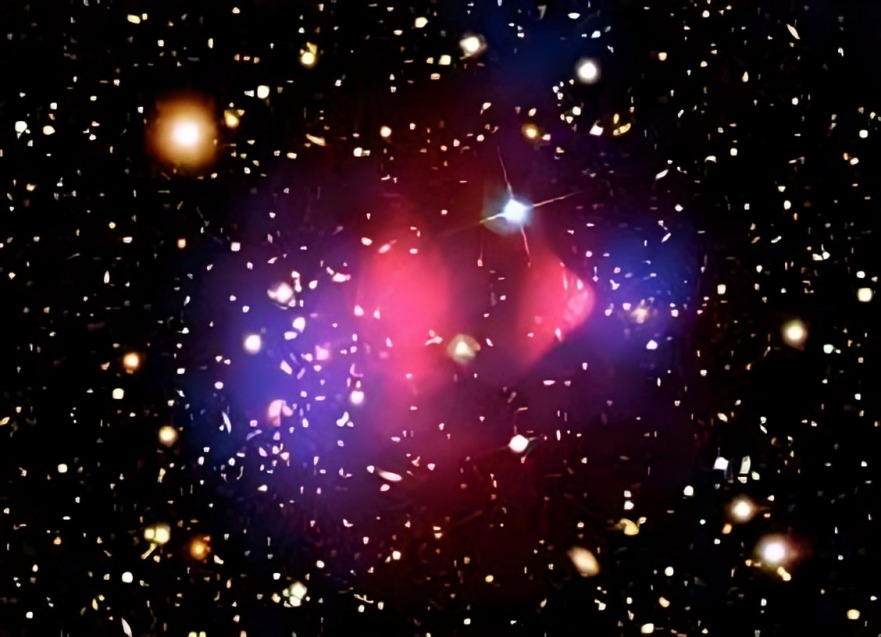
For years, astronomers have been fascinated by galaxies that seemed to challenge our understanding of the universe. Among the most puzzling was a so-called “dark matter galaxy”—a system thought to be almost entirely invisible except for the faint stars sprinkled within it. But new research suggests that one such galaxy might not be so dark after all, shaking up the way scientists think about cosmic structures and the mysterious substance we call dark matter.
A Galaxy That Defied Expectations
The galaxy in question, often cited as being “dark matter-dominated,” appeared to be missing something fundamental: stars. Most galaxies we know, including our Milky Way, shine with the light of billions of stars, gas clouds, and nebulae. But this unusual system seemed to contain very little visible matter at all, leaving astronomers to believe that the bulk of its mass was invisible dark matter.
Dark matter is the elusive material that makes up roughly 85% of the universe’s mass, yet it doesn’t emit, absorb, or reflect light. Its presence is usually inferred by the way galaxies rotate or how light bends as it travels past massive cosmic objects. A galaxy seemingly made almost entirely of dark matter offered scientists an intriguing laboratory to study this mysterious substance.
The Surprising New Findings
Recent observations, however, paint a different picture. Using more advanced instruments and sharper data, astronomers have found that the galaxy may contain far more stars and normal matter than previously believed. What once looked like an object cloaked in invisibility is now being revealed as a more typical galaxy—one that might have been mischaracterized due to the limitations of earlier observations.
In other words, this “dark” galaxy may not be dominated by dark matter after all. Instead, it could simply be a faint, low-surface-brightness galaxy that’s harder to detect with traditional telescopes but not so unusual once viewed with modern technology.
Why This Matters for Science
The discovery has important implications. If this galaxy isn’t as dark matter–rich as thought, it raises questions about how many other galaxies may have been misunderstood. It also suggests that astronomers need to refine their tools and methods when studying faint objects at the edges of detectability.
For dark matter research, this is both a setback and a step forward. A setback because one of the clearest “pure dark matter” candidates is no longer what it seemed—but also a step forward because the clarification helps eliminate false leads and refocus efforts on galaxies that truly defy conventional physics.
A Reminder About Cosmic Mysteries
The case of the “not-so-dark” galaxy highlights one of the challenges in astronomy: the universe doesn’t always reveal its secrets easily. What seems groundbreaking one year can be overturned the next by better data. And while that might sound frustrating, it’s also how science progresses—by questioning assumptions and updating theories with each new discovery.
Conclusion
This galaxy may not be as mysterious as once believed, but dark matter itself remains one of the biggest unsolved puzzles in modern science. If anything, this revelation sharpens the hunt by reminding astronomers to be cautious, precise, and open to surprises. After all, the cosmos is full of wonders—and sometimes, even when the darkness fades, the mystery deepens.
Would you like me to expand this into a popular science explainer with visuals and analogies (e.g., comparing dark matter to an invisible glue), so it’s more engaging for general readers?
