
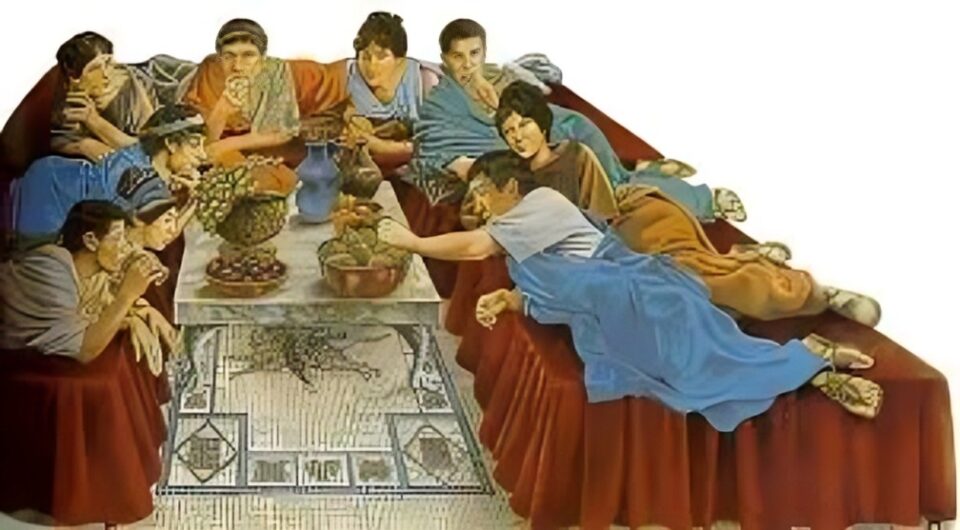
Picture a lavish Roman villa: mosaic floors glimmering beneath soft candlelight, walls painted with mythological scenes, the air thick with the scent of myrrh and roasted meats. In the center of the room, guests lounge on cushioned couches, sipping wine from silver cups, speaking in verse, and nibbling on stuffed dormice and honeyed figs—not while sitting upright, but while reclining.
To modern eyes, this practice might seem indulgent, lazy, or even uncomfortable. But in ancient Rome, dining while lying on your side was far more than a question of comfort. It was a performance of power, a ritual of social hierarchy, and a reflection of centuries of cultural tradition inherited and adapted from the Greeks. To eat reclined was to declare, without words, “I am free, I am elite, and I live above the burdens of common life.”
A Borrowed Luxury: The Greek Origins
The Romans didn’t invent the idea of reclining while dining—they borrowed it. The tradition originated in ancient Greece, particularly during the Classical period (5th–4th century BCE). In Greek symposia—intimate all-male gatherings for drinking, debate, and entertainment—participants would recline on couches while engaging in conversation and indulging in lavish meals.
To the Greeks, reclining was more than leisurely—it symbolized equality among aristocrats and created a space for philosophical thought, artistic performance, and intellectual bonding. When Rome conquered Greece in the 2nd century BCE, it absorbed not only Greek territories but also Greek art, literature, education systems—and social customs. The practice of reclining while dining was one of the many Hellenistic ideals Roman elites were eager to emulate, and eventually outdo.
The Roman Triclinium: More Than a Dining Room
The typical Roman dining space was called a triclinium, from the Greek tri- (three) and kline (couch). A proper triclinium featured three couches arranged in a U-shape around a central table. The fourth side was left open so slaves could come and go, delivering food, pouring wine, and removing empty dishes.
Each couch was designed to hold three diners, and where one reclined on the couch was no small matter—it reflected your social status in the room. The most honored guest would lie on the central couch in the middle position, with the host seated to his right. Others were arranged accordingly by prestige. Every placement was carefully calculated.
Guests would rest on their left elbows, leaving their right hands free for eating and drinking. Food was served in courses and often eaten with the fingers, though spoons were used for soups and stews. Napkins were provided, and bowls of water or rosewater were sometimes placed nearby for hand washing between courses.
Eating as a Social Event—and Status Symbol
In ancient Rome, eating was rarely a private activity for the elite. Meals—especially the convivium, or dinner party—were highly social and performative occasions. They were platforms for conversation, poetry, music, political networking, and intellectual sparring.
To dine reclining was to visibly distance oneself from the world of labor. It was a bodily declaration that one had the time, the means, and the freedom to eat slowly, luxuriously, and without urgency. This posture separated the ruling class from the working class, the free from the enslaved, the citizens from the outsiders.
Slaves, of course, were not permitted to recline. They stood or sat to eat—if they were allowed to eat with their masters at all. For lower-class Romans, meals were simple, often eaten sitting on stools or standing in kitchens or taverns. Reclining was, quite literally, the posture of privilege.
Symbolism Beyond Status: Reclining and the Divine
There was also spiritual and philosophical symbolism attached to reclining. Romans believed that the gods themselves reclined during celestial banquets. In art and sculpture, deities and mythic heroes are often depicted lounging while being served ambrosia and nectar. By reclining, mortals mimicked the divine and aligned themselves with a higher realm of pleasure and intellect.
Even in death, this symbolism endured. Roman funerary art often shows the deceased reclining at an eternal feast, enjoying a never-ending convivium in the afterlife. For many, reclining was not just a gesture of luxury—but a hopeful glimpse of immortality.
Gender and the Couch: Who Was Allowed to Recline?
In early Roman history, women—even elite ones—were not permitted to recline at banquets. Female modesty was idealized, and public displays of indulgence were frowned upon. Women were expected to remain upright and reserved, eating separately or sitting alongside the reclining men, not among them.
However, by the time of the Roman Empire, social norms began to shift. Influenced by the cosmopolitan nature of the empire and the growing power of wealthy Roman women, upper-class women began reclining alongside men at feasts. Some female figures, like Livia Drusilla (wife of Augustus) and Agrippina the Younger, were known to hold considerable influence in social and political spaces—including at the dinner table.
Still, these privileges were not universal. For much of Roman history, a woman reclining at a banquet was making a bold—sometimes scandalous—statement of independence and status.
Health and Comfort: Was It Practical?
Modern readers might wonder: was reclining actually comfortable—or even healthy?
Surprisingly, many medical historians suggest that reclining on the left side may have aided digestion by allowing the stomach to remain in a more natural position for food to enter. The left-sided recline also freed the right hand for eating. However, the posture wasn’t ideal for those with poor digestion or certain physical ailments, and it certainly wasn’t suitable for quick meals or manual laborers.
But practicality was rarely the point. The Roman elite were not eating for fuel; they were eating for show, connection, and status. Meals were drawn out over hours—sometimes even days—and comfort, while important, came second to symbolism.
Conclusion
To dine while reclining in ancient Rome was to make a statement: “I belong to the ruling class.” It was a practice woven with threads of history, politics, art, gender, and even spirituality. Every couch in a triclinium was a stage, and every guest a performer in the ongoing drama of Roman identity and influence.
So next time you kick back on your couch with a snack, remember—you’re not just lounging. You’re participating in a 2,000-year-old ritual of relaxation, power, and indulgence. The Romans did not eat to survive. They dined to display, to delight, and to declare their place in the grand architecture of the empire.
Let me know if you’d like a version shortened for social media, optimized for SEO, or translated into simpler language.
