
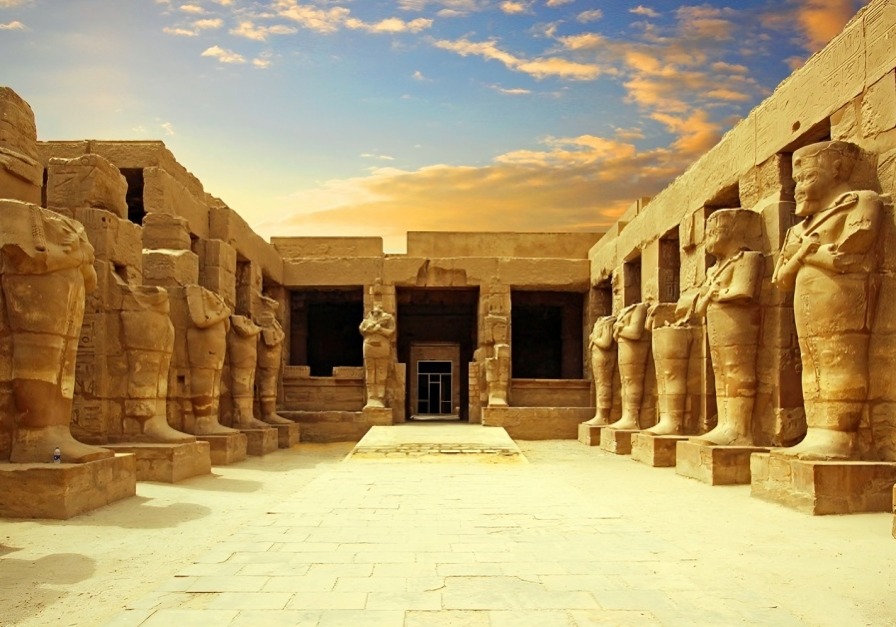
The story of ancient Egypt is a journey back to one of the most iconic civilizations in human history—a land of towering pyramids, powerful pharaohs, and a deep connection to the Nile River. But how did this incredible civilization begin? What forces came together to give rise to such a lasting culture?
Let’s explore how ancient Egypt rose from scattered farming communities to a mighty empire that shaped the ancient world.
The Gift of the Nile
The heart of Egypt’s success was the Nile River. Often called “the lifeblood of Egypt,” the Nile provided fertile soil through annual floods, fresh water for drinking and farming, and an easy transportation route that connected people up and down the valley.
Unlike the unpredictable rivers in other parts of the world, the Nile floods like clockwork every year. This consistency allowed early Egyptians to build a reliable agricultural system. Villages formed near the riverbanks and gradually grew into towns and trade centers.
In a sense, without the Nile, there would be no Egypt.
From Small Settlements to a Unified Kingdom
Around 5000 BCE, Neolithic (New Stone Age) farmers began settling in the Nile Valley. They raised crops like wheat and barley, herded animals, and created pottery. Over time, these farming communities became more organized and socially complex.
By about 3200 BCE, Egypt was divided into Upper Egypt (in the south) and Lower Egypt (in the north). Each region had its own king. But eventually, a powerful ruler from the south—believed to be King Narmer (also known as Menes)—unified the two regions around 3100 BCE, becoming the first pharaoh of a united Egypt.
This unification marked the beginning of the First Dynasty and launched Egypt into the period known as the Early Dynastic Period.
The Role of Religion and the Pharaoh
Religion turned into the middle of Egyptian life. Egyptians believed their gods controlled everything—from the flooding of the Nile to life after death. The pharaoh wasn’t just a king; he was considered a living god on Earth, the link between humans and the divine.
This belief helped hold the country together. People obeyed the pharaoh not only out of respect, but also out of spiritual duty.
The construction of grand temples and, later, pyramids reflected the importance of religion and the pharaoh’s role in the afterlife. These massive projects also created jobs, promoted new technologies, and helped the state grow stronger.
Advancements in Writing, Architecture, and Government
As Egypt developed, so did its writing system—hieroglyphics. First used for religious texts and royal records, writing allowed Egyptians to track history, laws, trade, and knowledge.
They also mastered architecture, building complex structures like temples, tombs, and eventually the iconic pyramids of Giza during the Old Kingdom.
A centralized government with appointed officials, tax systems, and an organized army gave ancient Egypt the structure it needed to expand and maintain power across centuries.
Trade and Contact With Other Cultures
Ancient Egypt didn’t rise in isolation. It traded with nearby regions such as Nubia, the Levant, and Mesopotamia. Through these connections, Egypt gained valuable goods like gold, incense, cedarwood, and lapis lazuli.
These interactions brought new ideas, materials, and technologies, which helped Egypt grow even stronger and more advanced.
Conclusion
The rise of ancient Egypt wasn’t the result of just one factor—it was a perfect blend of geography, agriculture, religion, leadership, and innovation. Over thousands of years, Egypt transformed from scattered farming villages into one of the most powerful civilizations the world has ever seen.
Even today, the legacy of ancient Egypt lives on—in museums, history books, and the sands of the desert where pyramids still stand as a testament to its greatness.
