
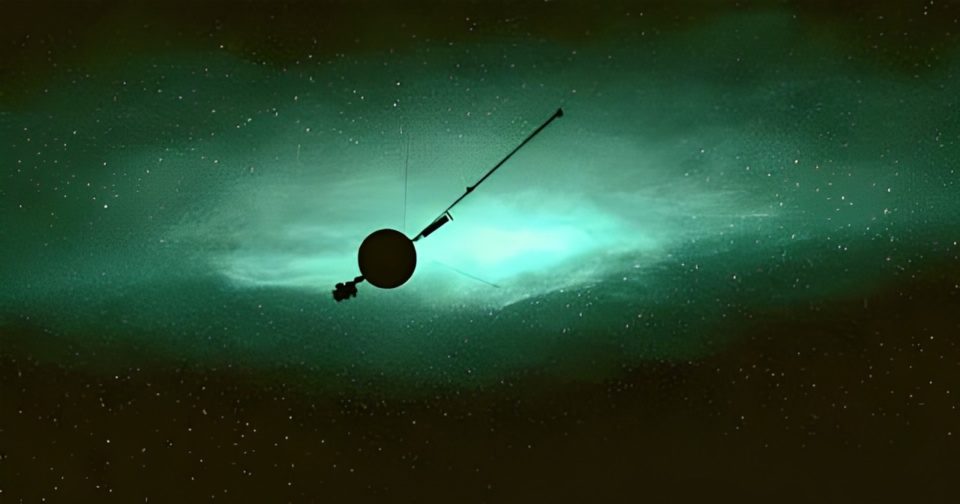
The Voyager spacecraft, launched by NASA in 1977, have embarked on an incredible journey through space, venturing farther than any human-made object has ever traveled. With their primary missions to explore the outer planets of our solar system long completed, the Voyager 1 and Voyager 2 probes continue to send back data as they travel through interstellar space. But what lies ahead for these intrepid explorers.Let’s delve into where Voyager might be in a billion years.
The Current Status of Voyager
As of now, Voyager 1 and Voyager 2 are in interstellar space, the region beyond our solar system’s heliosphere where the influence of the solar wind is weaker than that of the interstellar medium. Voyager 1 is approximately 14 billion miles from Earth, and Voyager 2 is around 12 billion miles away. Both spacecraft continue to operate and send back data, although their power sources are expected to run out by 2025, ending their ability to communicate with Earth.
The Journey Ahead
Once the power sources of the Voyager spacecraft are depleted, they will continue their silent journey through the Milky Way galaxy. Without propulsion systems, they are carried forward solely by their initial momentum. Their trajectories will take them through the interstellar medium, a vast expanse of gas, dust, and cosmic rays.
A Billion Years from Now
In a billion years, the Voyagers will be far from our solar system, having traveled roughly 1,000 light-years from their current positions. By then, they will have traversed multiple regions of the Milky Way. Here are a few key points about their future journey:
Interstellar Space
Both spacecraft will continue to drift through the interstellar medium, unaffected by the gravitational pull of the Sun. The density of particles in this region is incredibly low, so the Voyagers will remain largely unchanged.
Encounters with Stars
Over the course of a billion years, the Voyagers may pass relatively close to other stars. These encounters are extremely rare due to the vast distances between stars. For example, in about 40,000 years, Voyager 1 is expected to pass within 1.6 light-years of the star Gliese 445, but such encounters will be infrequent on a galactic scale.
Galactic Orbit
The Milky Way galaxy itself is in motion, and so are the Voyagers. They will orbit the center of the Milky Way, completing several orbits over the course of a billion years. Their paths will be influenced by the gravitational forces of stars, nebulae, and dark matter within the galaxy.
Cosmic Longevity
The durability of the Voyager spacecraft is a testament to human engineering. Without atmospheric drag or significant gravitational influences, they will continue their journey indefinitely. The only significant threat to their physical integrity would be collisions with interstellar particles or objects, but these are extremely rare in the vast emptiness of space.
The Legacy of Voyager
The Voyager missions have left a lasting legacy, not just in the scientific data they have gathered, but also in the form of the Golden Records. These phonograph records contain sounds and images selected to portray the diversity of life and culture on Earth. In a billion years, these records will remain as time capsules of human civilization, drifting through the galaxy long after humanity has moved on.
Conclusion
In a billion years, the Voyager spacecraft will be silent wanderers in the vast expanse of the Milky Way, far beyond the reach of our solar system. Their journeys symbolize humanity’s curiosity and desire to explore the unknown. As they travel through interstellar space, they will remain as monuments to human achievement, silently carrying the story of our world into the depths of the cosmos.
