
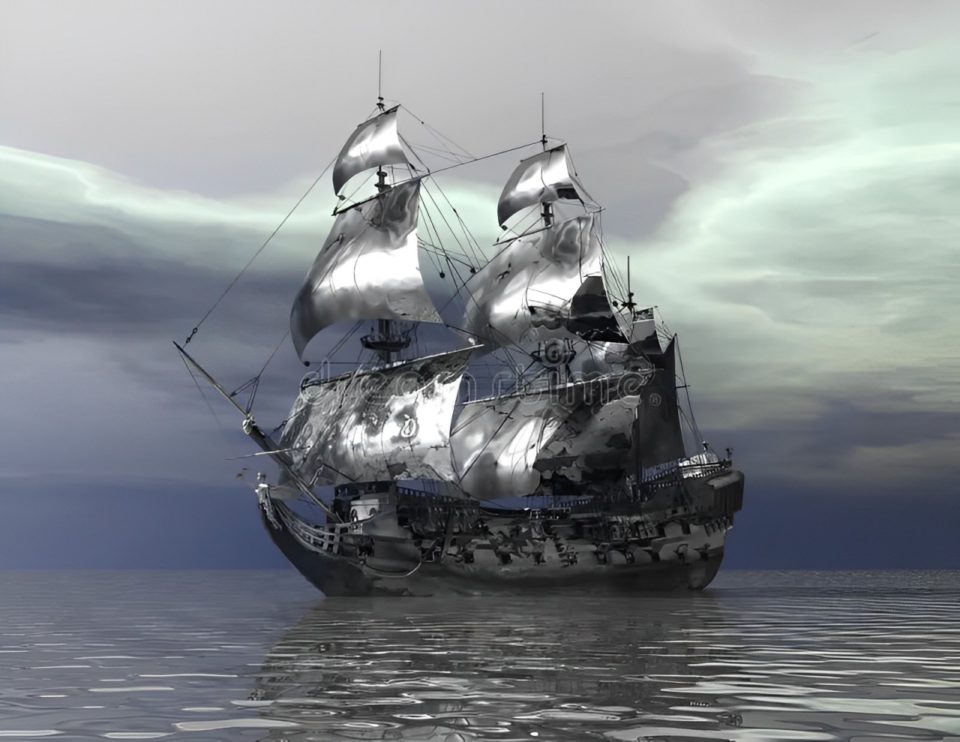
Maritime legends are a haunting blend of history and mystery, captivating imaginations with their tales of doomed voyages and restless spirits. One such story is that of the Lady Lovibond, a ghostly schooner said to reappear near Goodwin Sands every fifty years. Steeped in tragedy, this tale continues to intrigue sailors and folklore enthusiasts alike.
What draws Lady Lovibond back to these perilous sands? To answer this, we must explore the origins of the legend, the nature of Goodwin Sands, and the enduring fascination with ghost ships.
The Tragic Tale of the Lady Lovibond
The story begins in February 1748 when Captain Simon Reed set sail on the Lady Lovibond to celebrate his wedding to the love of his life, Annette. Ignoring maritime superstitions that forbade women aboard ships, Reed brought his bride along, turning the voyage into a honeymoon on the open sea.
Unbeknownst to the couple, the first mate, John Rivers, harbored unrequited love for Annette. Consumed by jealousy and rage, Rivers sabotaged the ship by deliberately steering it into the treacherous Goodwin Sands—a notorious sandbank in the English Channel. The collision doomed the vessel and all aboard, turning a joyous celebration into a tragic maritime disaster.
The legend claims that the Lady Lovibond reappears as a ghostly vision every fifty years near the site of its demise, shrouded in an eerie green glow.
Goodwin Sands: A Graveyard for Ships
Goodwin Sands has long been infamous among sailors. This shifting sandbank, located off the coast of Kent, England, is a natural trap for unwary vessels. Over the centuries, it has claimed hundreds of ships, earning its reputation as a “ship graveyard.”
What makes Goodwin Sands so treacherous is its deceptive nature. The sandbank is submerged during high tide but rises dangerously close to the surface at low tide, creating an ever-changing hazard. The combination of these factors has made it a magnet for shipwrecks and, by extension, maritime legends like that of the Lady Lovibond.
The Ghostly Return
The Lady Lovibond reportedly reappears every fifty years—1848, 1898, 1948, and so on. Witness accounts describe a spectral schooner, her sails billowing despite the absence of wind, with ghostly figures visible on deck.
Some speculate that the ship’s reappearance is tied to unresolved emotions—the betrayal, jealousy, and heartbreak of that fateful voyage. Others see it as a cautionary tale, reminding sailors of the dangers of ignoring maritime traditions and the deadly allure of Goodwin Sands.
While modern science dismisses such sightings as optical illusions, tricks of light, or the effects of fatigue on sailors, the legend endures.
Why Does Lady Lovibond Fascinate Us?
The story of Lady Lovibond touches on universal themes of love, jealousy, and tragedy, making it resonate across generations. Ghost ship legends like this one also tap into our fear of the unknown and the sea’s unrelenting power.
Moreover, the ship’s cyclical reappearance adds an element of suspense and wonder, as each fifty-year mark invites a fresh wave of curiosity and speculation. Whether the Lady Lovibond is a true ghost ship or a figment of collective imagination, it remains a compelling part of maritime lore.
Conclusion
The Lady Lovibond and her spectral visits to Goodwin Sands remind us of the sea’s capacity to inspire both awe and terror. Whether viewed as a cautionary tale, a love story gone wrong, or a chilling ghostly phenomenon, her legend endures in the hearts of those who hear it.
Perhaps Lady Lovibond is drawn back to Goodwin Sands not by supernatural forces, but by the enduring power of her story—a tale that continues to captivate and haunt us, generation after generation.
