
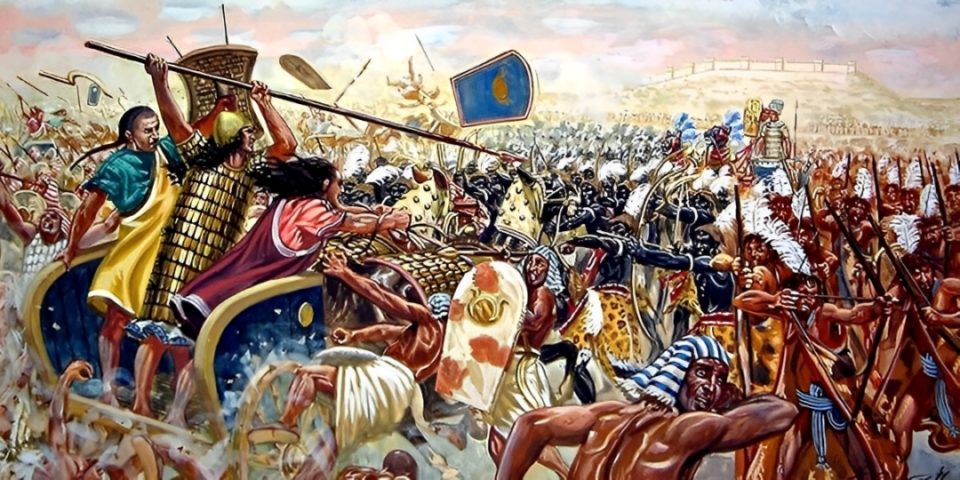
The Bronze Age (circa 3300–1200 BCE) was a transformative period marked by the rise of powerful civilizations, advances in metallurgy, and the development of large-scale warfare. As empires expanded, their territorial ambitions often led to conflicts over key trade routes and strategic cities. Among the many battles that shaped this era, none is as famous or well-documented as the Battle of Kadesh (circa 1274 BCE), fought between the Egyptian Pharaoh Ramesses II and the Hittite King Muwatalli II. This battle, waged near the city of Kadesh in present-day Syria, is considered one of the largest chariot battles in history and played a crucial role in shaping the geopolitical landscape of the Near East.
Background: The Struggle for Kadesh
During the late Bronze Age, two dominant empires, Egypt and the Hittites, were locked in a struggle for control over the Levant—a critical region rich in resources and trade routes.
The Egyptian Empire, under Ramesses II, sought to reclaim lost territories and expand its influence in the north.
The Hittite Empire, led by Muwatalli II, was equally determined to resist Egyptian advances and maintain dominance over key cities, including Kadesh.
Kadesh held immense strategic importance as it was a fortified city located at a crossroads of major trade routes. Whoever controlled Kadesh had significant power over commerce and military movements in the region. The rising tensions between these two superpowers ultimately led to a massive clash.
The Battle Begins: A Tactical Deception
Ramesses II led a formidable Egyptian army, divided into four divisions:
- Amun
- Ra
- Ptah
- Set
Each division consisted of thousands of soldiers, archers, and charioteers. Confident in his army’s might, Ramesses advanced toward Kadesh, believing he would easily reclaim the city. However, the Hittites had an elaborate plan to mislead the Egyptians.
The Hittite Ambush
Before the battle, Muwatalli II deployed Hittite spies who provided false intelligence, tricking the Egyptians into believing that the Hittite army was far away. This miscalculation led Ramesses to position his troops recklessly, allowing the Hittites to launch a surprise attack on the Ra division, which was moving ahead of the main Egyptian forces.
As thousands of Hittite chariots, built for speed and precision, crashed into the unsuspecting Egyptian troops, chaos erupted. The Egyptian forces were caught off guard and suffered heavy losses.
Ramesses II’s Counterattack
Despite the unexpected attack, Ramesses II refused to surrender. Displaying remarkable leadership, he personally led his remaining troops in a daring counteroffensive. Gathering his elite warriors and rallying the disoriented Egyptian forces, he launched a bold counterattack against the Hittite forces.
As the battle raged on, Egyptian reinforcements from the Ptah division arrived just in time, helping to stabilize the Egyptian position. The tide of battle shifted, forcing the Hittites to retreat toward Kadesh. However, Ramesses lacked the strength to capture the city completely, leading to a military stalemate.
The Aftermath: A Stalemate and the First Peace Treaty
Neither Egypt nor the Hittites achieved a decisive victory at Kadesh. While Ramesses II portrayed the battle as a great triumph in Egyptian records, the reality was more complex. The battle ended in a military stalemate, with neither side gaining full control over Kadesh.
Realizing that continued warfare was unsustainable, both empires eventually sought diplomatic solutions. The long-term outcome of the battle was the signing of the Egyptian-Hittite Peace Treaty around 1259 BCE, considered the first recorded peace treaty in history. This treaty established clear borders and ensured a fragile peace between the two great powers.
Why the Battle of Kadesh Was So Important
The Battle of Kadesh remains one of the most significant battles of the Bronze Age for several reasons:
The Largest Chariot Battle in History
Kadesh saw the deployment of thousands of war chariots, demonstrating the pinnacle of chariot warfare in the ancient world. The Hittite chariots, designed for speed and power, clashed with Egyptian chariots, which emphasized maneuverability and long-range attacks.
A Testament to Early Propaganda
Ramesses II, eager to solidify his legacy, commissioned numerous inscriptions, reliefs, and temple carvings depicting him as the victorious hero of Kadesh. These accounts, though exaggerated, provide valuable insights into ancient propaganda and state-controlled narratives.
The First Recorded Peace Treaty
The battle’s aftermath led to one of the earliest diplomatic agreements in human history. The Egyptian-Hittite Peace Treaty serves as an example of early international diplomacy, highlighting the importance of negotiation even in ancient times.
Strategic and Military Lessons
The battle exposed weaknesses in Egyptian military strategy, particularly their over-reliance on intelligence reports. It also showcased the effectiveness of large-scale surprise attacks and the role of logistics and reinforcements in determining battle outcomes.
Conclusion
The Battle of Kadesh stands as one of the most legendary and well-documented conflicts of the ancient world. Though it did not result in a clear military victory for either side, its impact was profound. It marked a turning point in Egyptian-Hittite relations, leading to the first known peace treaty and setting a precedent for future diplomatic resolutions of conflicts.
Furthermore, Kadesh remains a fascinating case study in ancient warfare, showcasing the complexity of Bronze Age military tactics, the significance of chariot-based combat, and the importance of propaganda in shaping historical narratives. Whether viewed through the lens of strategy, diplomacy, or historical record-keeping, the Battle of Kadesh continues to captivate historians and enthusiasts alike, offering valuable lessons from a time when great empires clashed for dominance in the ancient world.
