
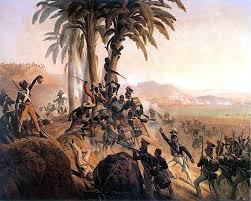
The Haitian Revolution (1791–1804) stands as one of the most transformative and brutal uprisings in world history. It was the first and only successful slave revolt that led to the founding of a free nation—Haiti—ruled by formerly enslaved people. But the path to freedom was paved in blood, fire, and unimaginable suffering. Behind the glory of independence lies a grim history of horrors, revenge, and human endurance that reshaped the Atlantic world forever.
A Society Built on Cruelty
Before the revolution, Saint-Domingue (modern-day Haiti) was France’s most profitable colony, supplying Europe with sugar, coffee, and indigo. But that wealth came at a staggering human cost. Over 500,000 enslaved Africans labored under horrific conditions on plantations. The system was one of brutal violence, psychological torture, and dehumanization.
- Enslaved workers were routinely whipped, mutilated, or killed for the slightest resistance.
- Runaways were tortured or executed in public as warnings.
- Mortality rates were so high that enslaved people were constantly imported, with little regard for survival.
Saint-Domingue was essentially a powder keg, and in 1791, it finally exploded.
Uprising: A War Fueled by Rage
The revolt began with a secret meeting known as the Bois Caïman ceremony, where enslaved leaders vowed to rise up. What followed was a revolution of astonishing scale and brutality:
- Plantations were burned to the ground by the thousands.
- White planters and their families were often killed in acts of violent retribution.
- Mobs of enslaved people, armed with machetes, torches, and stolen weapons, swept through the countryside seeking liberation—and vengeance.
This wasn’t just a war—it was a reckoning. Centuries of oppression fueled a rebellion that stunned the world.
Vicious Counterattacks
The white colonists, and later the French military, responded with equally horrific violence. Mass executions, torture, and re-enslavement followed every recaptured area.
- Public hangings and beheadings were common.
- Rebel leaders were burned alive or broken on the wheel.
- Entire communities were wiped out in reprisals.
Even the arrival of French revolutionary ideals in the 1790s—”liberty, equality, fraternity”—could not contain the chaos. France’s own hypocrisy in trying to suppress the revolution while preaching freedom deepened the conflict.
Disease, Starvation, and Siege
War wasn’t the only killer. Famine swept across the colony. Infrastructure collapsed. Crops were torched. Towns were razed. And then came the mosquitoes.
Thousands of French soldiers sent to crush the rebellion died from yellow fever and malaria, diseases that the tropical environment used as a silent ally to the rebels. By 1803, Napoleon’s dreams of a Western empire had crumbled—not just from battle, but from nature’s vengeance.
Atrocities on All Sides
The revolution’s violence was not one-sided. As the formerly enslaved armies gained power, they too committed atrocities. In 1804, after Haiti declared independence, Jean-Jacques Dessalines ordered the massacre of most remaining white settlers—a calculated and chilling act meant to prevent future colonization or retaliation.
- Between 3,000 and 5,000 people were killed in what is now known as the 1804 Haiti Massacre.
- Even women and children were not spared in many cases.
These acts remain controversial, seen by some as genocide, and by others as a bloody but inevitable end to centuries of enslavement.
Conclusion
The Haitian Revolution was a triumph of human will—but it came at a horrific cost. It forced the world to confront the realities of slavery, colonialism, and Black sovereignty in a way no prior movement had. Haiti’s victory inspired abolitionist movements across the globe, but also led to international isolation, economic sanctions, and decades of poverty and instability.
Today, the revolution is both a symbol of freedom and resilience, and a haunting reminder of what human beings are capable of—on both sides of oppression.
The horrors of the Haitian Revolution should not be forgotten. They are not just a dark chapter in Caribbean history—they are a lesson in what it takes to break chains, and the terrible price sometimes paid for liberty.
