
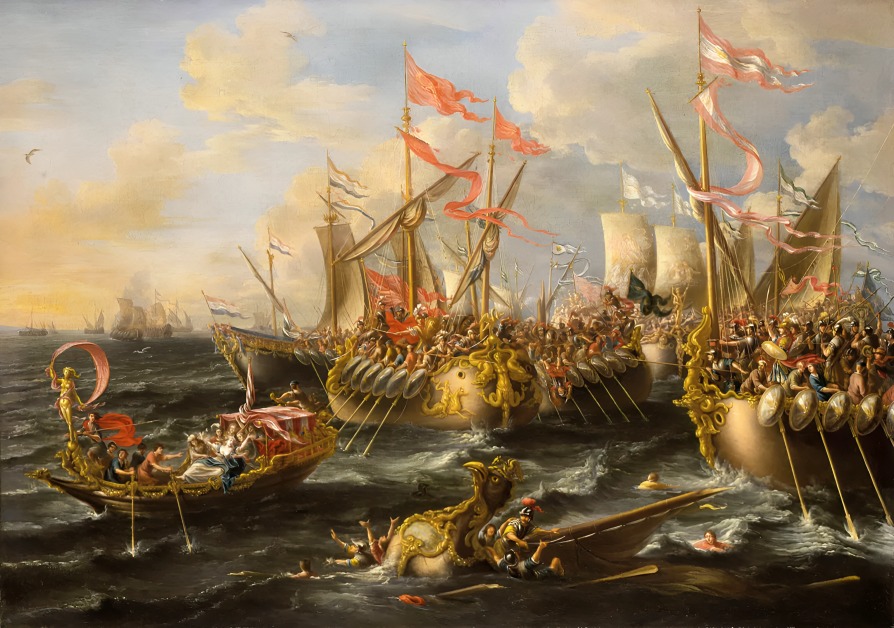
The Battle of Actium, fought on September 2, 31 BCE, was one of the most decisive confrontations in ancient history—one that not only marked the fall of a great Roman leader, Mark Antony, but also sealed the fate of the Hellenistic world. At the heart of this historic naval clash was a moment still debated by historians and dramatized by poets: the unexpected desertion of Cleopatra VII, Queen of Egypt. Her sudden flight from the battlefield would cripple Antony’s strategy, devastate his morale, and ultimately lead to his downfall.
The Stakes at Actium
By 32 BCE, Rome was on the brink of civil war. Mark Antony, once Caesar’s trusted general, had allied himself with Cleopatra both politically and romantically. Their union posed a serious threat to Octavian, Caesar’s adopted son and political heir. Antony’s enemies in Rome framed his relationship with Cleopatra as a betrayal, accusing him of abandoning Roman values and pledging allegiance to the “foreign queen.” As tensions escalated, both sides prepared for an all-out war that would determine the future of the Roman Empire.
The showdown came at Actium, a promontory on the western coast of Greece. Antony and Cleopatra assembled a massive fleet, composed largely of Egyptian and Eastern vessels. Octavian’s forces, under the brilliant command of Marcus Agrippa, took a more strategic approach, disrupting Antony’s supply lines and drawing him into a battle he was ill-prepared for.
Cleopatra’s Role in the Campaign
Cleopatra was not a passive observer in the campaign. She brought Egypt’s formidable naval power and vast financial resources to the war effort. Her fleet, anchored alongside Antony’s, was essential for holding their position. Cleopatra had her own command, and according to several sources, she was aboard a large royal galley positioned behind Antony’s front lines.
But unlike the Roman commanders, Cleopatra was no seasoned general. While her support was indispensable, her priorities may have been different from Antony’s. For Cleopatra, preserving her throne and Egypt’s independence was paramount. As the battle took a dire turn, it became clear that Antony’s forces were no match for the superior maneuverability and tactics of Agrippa’s navy.
The Flight That Changed Everything
At the height of the battle, with the Roman lines pressing in and confusion spreading, Cleopatra made a stunning decision. She turned her ships away from the battle and fled through a gap in the fighting line with a dozen or more vessels. Some sources suggest that her retreat was premeditated, while others argue it was a panicked response to what she saw as a lost cause.
Antony, upon seeing Cleopatra retreat, made a fateful choice. Rather than rally his men or regroup his fleet, he broke from the fight and followed her. In that single moment, Antony’s command crumbled. Leaderless and demoralized, his troops fell into disarray. Octavian’s forces capitalized on the chaos, capturing or destroying much of Antony’s remaining fleet.
Why Did Cleopatra Flee?
The motives behind Cleopatra’s desertion remain speculative. Some historians argue she was acting on a prearranged plan with Antony—to retreat and regroup in Egypt if the tide turned. Others believe she panicked and prioritized self-preservation. There are even darker interpretations: that Cleopatra saw the writing on the wall and was ready to cut her losses, leaving Antony to face the consequences alone.
Regardless of her intent, the symbolism of her flight was powerful. It painted a picture of betrayal and abandonment—one that Octavian would use skillfully in his propaganda, portraying Antony as the lovesick fool who threw away Rome’s glory for an Egyptian queen.
Aftermath and Tragic Ends
In the months that followed, Octavian pursued Antony and Cleopatra back to Egypt. Their forces dwindled, their support eroded, and both knew the end was near. In August of 30 BCE, facing inevitable capture, Antony fell on his sword. Cleopatra followed days later, reportedly by suicide—though the exact method remains a mystery.
With their deaths, Egypt became a Roman province, and Octavian, later Augustus, secured his place as the first Roman Emperor. The ancient world shifted forever.
Conclusion
The desertion of Cleopatra at Actium stands as one of history’s most debated military decisions. Whether it was an act of betrayal, desperation, or miscommunication, its consequences were profound. It doomed Antony’s campaign, led to the fall of the last Ptolemaic monarch, and cleared the way for the rise of imperial Rome.
In hindsight, Actium was not just a naval battle—it was a clash of empires, personalities, and ambitions. And at its turning point was one woman’s fateful decision to turn her ship away, forever altering the course of history.
