
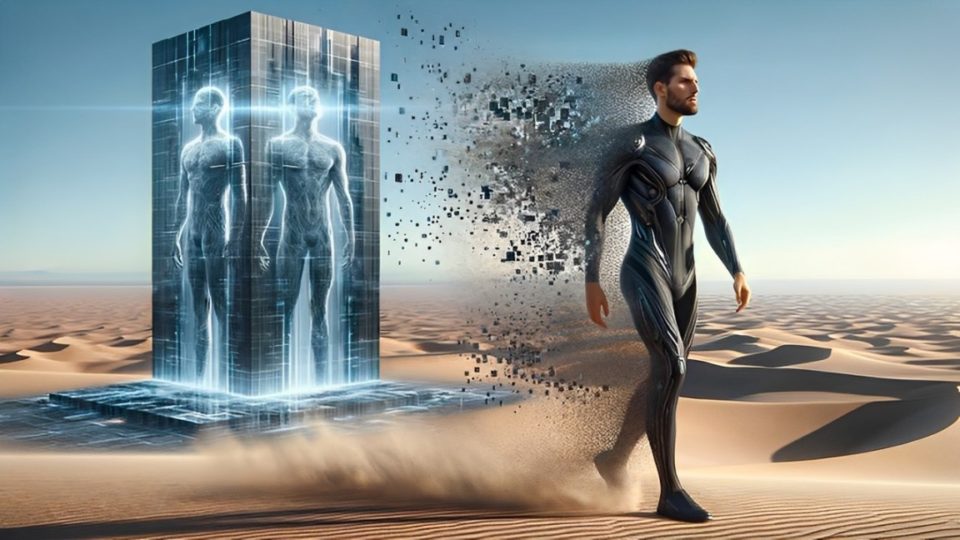
The idea that our reality might be an intricate simulation has gained popularity in recent years, both in scientific circles and mainstream culture. Philosophers, physicists, and even tech giants have pondered this question, exploring the possibility that our world is a highly advanced, computer-generated illusion. Although it sounds like something out of a science fiction novel, there is compelling evidence suggesting that our universe might indeed be a simulated environment. Here’s a breakdown of the theories and signs that support the “simulation hypothesis.”
Mathematical Patterns in Nature
One of the most intriguing arguments for a simulated universe is the appearance of mathematical patterns that underpin our reality. From the Fibonacci sequence in sunflowers and galaxies to fractal patterns found in coastlines and clouds, the universe seems to operate on a code. In our digital world, everything is built on binary code—ones and zeros—that determine how systems behave. Similarly, mathematical principles form the building blocks of nature, governing everything from atomic structures to the laws of physics. Could it be that our reality operates on a kind of cosmic code?
Quantum Physics and Pixelated Reality
In digital environments, everything is made up of pixels—the smallest unit of a digital image. In quantum physics, particles seem to behave similarly, existing in discrete units or “quanta.” Particles don’t have definite locations or velocities until they’re observed, much like pixels on a screen that only “appear” when called upon. This aligns with the idea of a simulated environment, where everything is rendered only when it’s observed or needed by a player—us. Nobel laureate Eugene Wigner and physicist John Wheeler have both proposed that reality requires observation to take form, a concept remarkably similar to how video games operate.
The Fine-Tuning of Universal Constants
Scientists have discovered that the universe’s fundamental constants are incredibly fine-tuned to support life. Constants like the gravitational constant, the speed of light, and the charge of electrons are precisely calibrated. Even the tiniest variation in these constants would render the universe inhospitable for life. If our universe were a simulation, this fine-tuning could be intentional—a deliberate calibration by programmers to create a stable environment capable of sustaining complex life forms.
The Bizarre World of the Mandela Effect
The Mandela Effect is the phenomenon where large groups of people remember details differently from how they actually are, such as people recalling the Berenstain Bears as the “Berenstein Bears” or believing that Nelson Mandela died in the 1980s when he actually died in 2013. Some interpret this phenomenon as evidence of “glitches” in the simulation or alternate versions of reality accidentally intersecting. While skeptics may attribute the Mandela Effect to faulty memory or suggestible thinking, simulation theory posits that these might be actual glitches—perhaps artifacts left over from a recent “software update” or altered lines of code.
The Uncanny Progression of Technology
As technology rapidly advances, our ability to create virtual worlds is approaching levels once unimaginable. Video games, virtual reality, and AI have reached a point where digital environments can almost mimic reality. According to Nick Bostrom’s simulation argument, if we can imagine creating hyper-realistic simulations ourselves, then it’s possible that an advanced civilization could have already achieved this and created our reality. Bostrom argues that, if it’s possible for civilizations to reach this level of technological sophistication, it’s more likely we are in a simulation than not.
Deja Vu and the Feeling of “Glitches”
Many people have experienced déjà vu—a strong sensation that an event currently happening has happened before. Some believe that déjà vu is evidence of a simulated environment, with these moments serving as glitches or resets in the code. These experiences, though hard to explain, have led some to speculate that déjà vu might be a glitch in the “matrix” of our world, providing subtle evidence that we’re living within a controlled, simulated environment.
Unsolved Mysteries and Unexplainable Phenomena
From the nature of consciousness to dark matter and dark energy, the universe is filled with unsolved mysteries that have stumped scientists for centuries. If our reality is a simulation, these phenomena could be limitations or complexities coded into the system. Consciousness, in particular, defies traditional explanation—it’s as though our awareness arises from something beyond the physical realm, almost as if it’s a part of the software, while our bodies and surroundings are merely the hardware.
Theoretical Support from Quantum Computing
Quantum computing is a field that explores the possibility of computations happening in parallel realities, using particles in multiple states simultaneously. If quantum computing is successful, it could provide the ability to simulate realities on a grand scale. In other words, if we can prove that it’s possible to build large-scale simulations, it could further validate the idea that our universe is itself a simulation, created by an advanced civilization or consciousness.
Consciousness as the Ultimate Puzzle
One of the strongest arguments for the simulation hypothesis is the mystery of human consciousness. Despite years of research, scientists still can’t fully explain why we have subjective experiences, feelings, or self-awareness. If we’re in a simulation, consciousness could be a kind of advanced artificial intelligence programmed to experience life from a first-person perspective. Our individual experiences could be a simulation’s most advanced coding element, designed to make the simulation more immersive and meaningful.
Conclusion
The idea that we live in a simulation is undoubtedly provocative, challenging the core of what we believe about existence. While these pieces of evidence don’t definitively prove the simulation hypothesis, they encourage us to consider it as a legitimate possibility. Whether or not our world is simulated, thinking of life as a designed experience can offer us a unique perspective. It reminds us to find meaning in the world around us, stay curious, and keep exploring the mysteries of our universe—simulated or not.
Who knows? One day, we might finally uncover the truth, and the simulation hypothesis will either fade into myth or become one of the greatest revelations in human history.
