
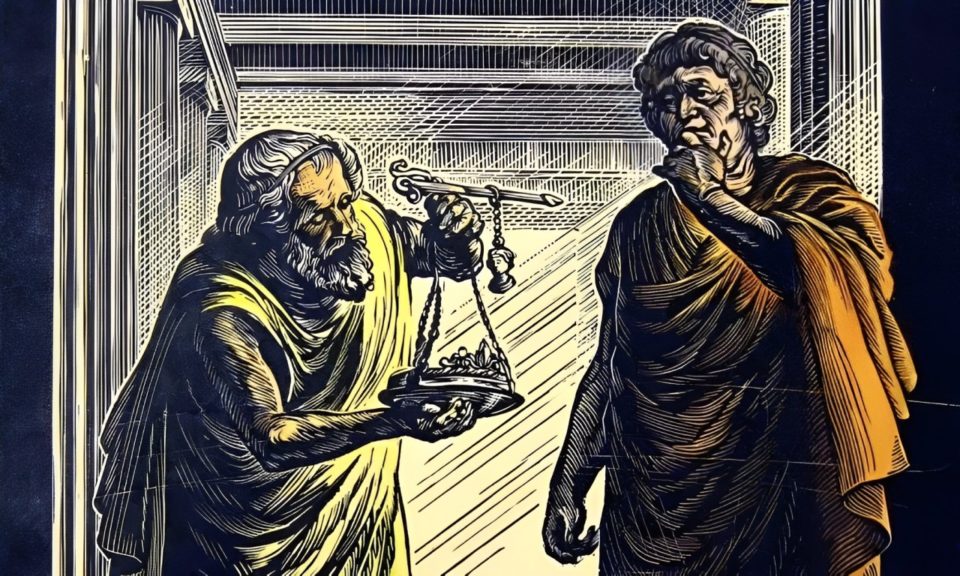
The tale of Archimedes and the royal jeweler is one of history’s most captivating anecdotes, showcasing the genius of ancient science and its application in solving real-world problems. This story, often retold with elements of drama and wonder, involves a challenge posed to Archimedes by none other than King Hiero II of Syracuse. The king suspected foul play by his royal jeweler and turned to Archimedes for a solution that would expose the truth without damaging the precious artifact in question.
The Suspicion
King Hiero II had commissioned a magnificent gold crown as an offering to the gods. He provided a specific amount of gold for its crafting and entrusted a renowned jeweler with the task. Upon receiving the finished crown, the king admired its beauty but harbored a nagging suspicion: was the crown made entirely of gold, or had the jeweler substituted some of the gold with a cheaper metal, such as silver, to pocket the difference?
To solve this mystery, the king sought the help of Archimedes, a mathematician, inventor, and physicist whose reputation for brilliance was already well-established.
The “Eureka” Moment
Archimedes’ challenge was to determine the crown’s composition without damaging it. The breakthrough reportedly came as Archimedes took a bath. Observing how the water level rose when he immersed himself, he realized that the volume of water displaced was directly proportional to the volume of his body. This insight could be applied to objects of irregular shape, such as the crown.
Archimedes is said to have been so elated by this discovery that he leapt out of the bath and ran through the streets of Syracuse shouting, “Eureka!” (Greek for “I have found it!”).
Putting the Principle to the Test
Armed with his newfound understanding of buoyancy and displacement, Archimedes devised a straightforward experiment. First, he measured the volume of the crown by submerging it in water and recording the amount displaced. Then, he compared this with the volume of an equal weight of pure gold. If the crown were pure gold, its density would match that of gold, and the displaced water would be identical in both cases.
As expected, the results revealed a discrepancy. The crown displaced more water than the gold of equivalent weight, indicating it had a lower density. This meant that the jeweler had indeed adulterated the crown with a lighter metal, likely silver.
The Outcome
Archimedes’ ingenious test exposed the jeweler’s deceit, and justice was served. The story not only highlights the brilliance of Archimedes but also underscores the importance of scientific principles in uncovering truth. His method, rooted in the principle now known as Archimedes’ Principle, laid foundational groundwork for the study of fluid mechanics and density.
Legacy of the Tale
Though details of the story have been embellished over centuries, the essence remains a testament to the power of observation, critical thinking, and the application of scientific concepts. Archimedes’ “Eureka” moment has become synonymous with sudden, brilliant insight, and his methods continue to inspire scientists and problem-solvers around the world.
Conclusion
The story of how Archimedes exposed the royal jeweler’s fraud is not just a fascinating piece of history; it serves as a profound example of how human ingenuity and scientific reasoning can triumph in the quest for truth and justice. This enduring tale transcends time, illustrating the importance of observation, analytical thinking, and ethical behavior. It reminds us that the principles discovered centuries ago continue to shape our understanding of the natural world and inspire innovative solutions to challenges we face today.
