
When we think of cities, we picture towering skylines, paved roads, and bustling crowds. But long before skyscrapers pierced the sky, long before maps had borders or names, there was a first—a city that marked the beginning of civilization as we know it.
Welcome to Earth’s first city. A place born not of concrete and steel, but of mud bricks, trade, ritual, and community.A place that redefined what it meant to be human.
Let’s take a journey back—over 9,000 years ago—to where urban life truly began.
Where It All Started: Mesopotamia, the Cradle of Civilization
Historians and archaeologists widely agree that the earliest cities rose in a region called Mesopotamia—the land between the Tigris and Euphrates rivers, in present-day Iraq. It was here, amid the fertile floodplains, that agriculture first took root, allowing humans to settle, store food, and build permanent homes.
As communities grew, something new emerged: cities.And at the heart of it all stood one name: Uruk.
Uruk: The World’s First True City
Dating back to around 4,000 BCE, Uruk is often considered the first major city in human history. It didn’t just have people—it had temples, walls, markets, neighborhoods, writing, and governance. Uruk was home to tens of thousands of people at a time when most humans still lived in small tribal groups.
What made Uruk special?
- Massive temples (ziggurats) built for gods like Inanna and Anu
- The earliest known writing system, cuneiform, carved on clay tablets
- A centralized economy, based on trade, agriculture, and crafts
- A kingdom and priesthood—an early form of organized government
- Walls and defense, suggesting conflict and cooperation were both present
In a very real sense, Uruk invented urban life.
Before Uruk: Çatalhöyük and the Proto-Cities
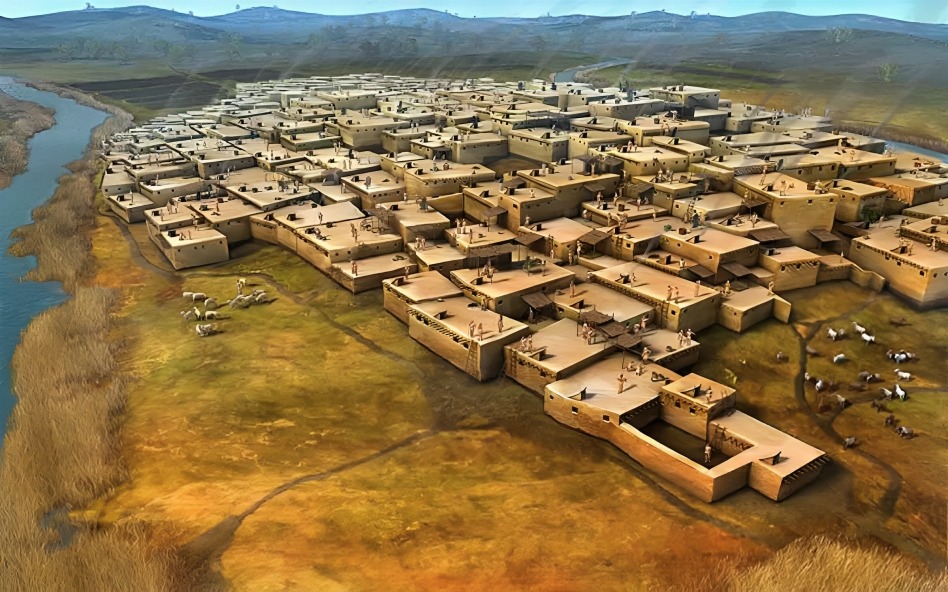
Before Uruk, there was Çatalhöyük, located in modern-day Turkey. Dating as far back as 7,500 BCE, it’s one of the oldest known human settlements. But it wasn’t quite a city—it lacked streets and clear social structures. Instead, homes were clustered close together with rooftop access, and the community revolved more around shared rituals and subsistence living.
Çatalhöyük tells us a lot about how humans transitioned from nomadic life to settled living—but it was cities like Uruk that brought writing, trade networks, political hierarchy, and urban planning into the mix.
Why Did Cities Form?
The birth of cities didn’t happen by accident. It was the result of several key shifts:
- Agriculture – Reliable food meant people could stop moving.
- Surplus – Stored grain = wealth = trade.
- Specialization – Not everyone had to farm anymore. People became potters, builders, priests.
- Religion and ritual – Temples became centers of power and community.
- Defense and walls – More people = more competition = need for protection.
- Record keeping – Writing was invented to track trade, taxes, and laws.
In short, cities emerged when survival gave way to society.
The Legacy of Earth’s First Cities
What started in Uruk rippled outward. Cities soon rose in Egypt (Thebes, Memphis), India (Mohenjo-daro), China (Anyang), and the Americas (Caral, Teotihuacan). Each had its own version of urban life, shaped by geography, beliefs, and innovation.
But the echoes of those first cities still live in our modern world:
- Laws and writing
- Taxes and trade
- Architecture and planning
- Religious and political institutions
- The idea that many people, strangers even, can live and work together in shared space
All of that began thousands of years ago—with a spark in the sand, by the banks of a river.
Conclusion
To look at Uruk, or Çatalhöyük, or ancient Thebes is to look at our beginning—not just of buildings, but of identity. These first cities marked the moment humans moved from surviving to organizing, from wandering to shaping the world around them.
When we ask where civilization began, we’re really asking:When did we choose to live not just beside one another—but together . And the answer lies in Earth’s first cities.Would you like a visual version of this article for a video, infographic, or social post series?
