
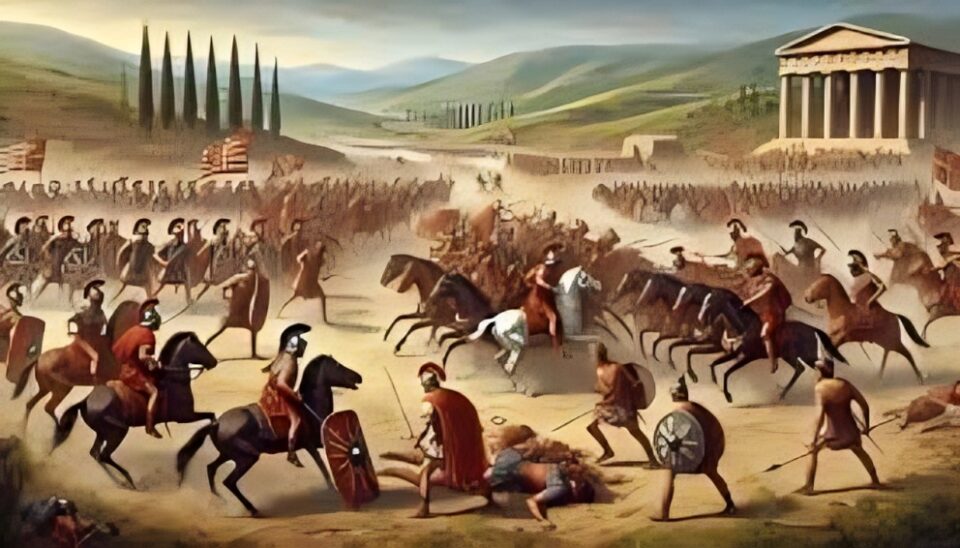
Before the Roman Empire dominated the Mediterranean, there was another power that ruled the seas, rivaled Roman strength, and challenged its destiny—Carthage. Known today mostly for its epic clash with Rome during the Punic Wars, Carthage’s origins go much deeper than its final battles. To understand why Rome feared this empire so much, we need to go back to the beginning—when Carthage was just a distant outpost in North Africa.
A Phoenician Beginning
Carthage was founded around 814 BCE by settlers from Tyre, a powerful city in Phoenicia (modern-day Lebanon). According to legend, the city was established by Queen Dido, a noblewoman fleeing political turmoil in her homeland. Whether myth or reality, the story reflects a core truth: Carthage was a Phoenician colony, built by sea traders and merchants who were already masters of commerce and navigation.
Its strategic location on the coast of modern-day Tunisia gave Carthage access to key trade routes in the western Mediterranean, allowing it to grow rapidly in wealth and influence.
A Maritime Power Rises
Carthage quickly transformed from a trading outpost into a bustling metropolis. Its navy became one of the most advanced of the ancient world, and its economy thrived on the trade of goods like silver, tin, textiles, wine, olive oil, and exotic goods from Africa and Iberia.
By the 5th century BCE, Carthage controlled territories in North Africa, Sardinia, Corsica, Sicily, and parts of Spain. This control over the sea and trade made it a dominant force—and a natural rival to the rising power of Rome.
A Culture Built on Commerce and Religion
Unlike Rome, which was focused on territorial conquest and military expansion, Carthage’s strength lay in commerce and diplomacy. Its society was deeply urban and merchant-based, with a powerful oligarchy of noble families managing the city’s wealth and government.
Carthage was also deeply religious, worshiping gods such as Baal Hammon and Tanit. Religious rituals, including animal (and possibly even human) sacrifices, were central to its identity, though much of what we know is filtered through hostile Roman accounts.
Rome Meets Its Match
For centuries, Rome and Carthage coexisted uneasily. But their interests eventually collided, especially over control of Sicily—a valuable island in the center of the Mediterranean. This led to the First Punic War (264–241 BCE), the beginning of a brutal rivalry that would last over a century.
Rome won the first war, but Carthage rebuilt quickly—especially under the leadership of the brilliant general Hannibal Barca, who famously led his army (and war elephants) across the Alps during the Second Punic War. His victories terrified Rome and nearly led to its downfall.
Even after eventual defeat, the mere memory of Carthage haunted Rome’s imagination. The Roman statesman Cato the Elder would end every speech with the phrase: “Carthago delenda est” — “Carthage must be destroyed.”
Conclusion
Carthage was finally destroyed in 146 BCE at the end of the Third Punic War, when Rome razed the city and enslaved its population. But the fear and respect Carthage inspired never faded. Rome built a new city over the ruins—but it could never erase the memory of its greatest rival.
Carthage was more than just an enemy—it was a mirror, a measure of Rome’s own ambition, strength, and vulnerability. And though it fell, the empire Rome feared most left behind a legacy that still echoes in the ruins along the Tunisian coast.
In the story of ancient power, Carthage is proof that even empires must face equals—and sometimes, enemies greater than themselves.
