
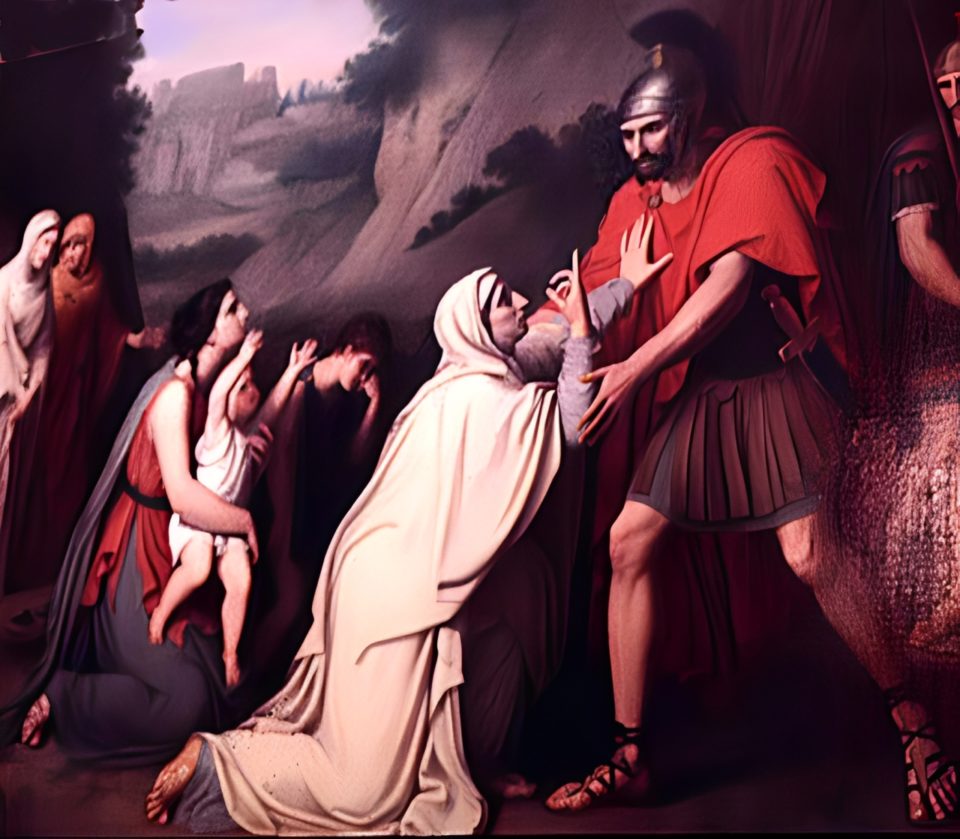
Gaius Marcius Coriolanus is one of the most polarizing figures in Roman history, embodying the tension between personal ambition and public duty. A celebrated military leader, he achieved glory on the battlefield, only to later turn against his homeland in an act that would label him a traitor in the eyes of many. Was Coriolanus a hero whose downfall was the result of political betrayal, or a man consumed by pride and vengeance?
The Hero on the Battlefield
Coriolanus first rose to prominence as a valiant soldier during the Roman siege of Corioli, a city of the Volsci. His daring and decisive actions in capturing the city earned him both victory for Rome and the honorific title “Coriolanus.” He was hailed as the epitome of Roman martial virtue—brave, disciplined, and relentless in his duty. His military achievements solidified his reputation as a hero of the Republic, a man whose courage and determination seemed unmatched.
The Political Divide
However, Coriolanus’ transition from soldier to politician exposed a darker side of his character. As a staunch patrician, he held deep disdain for the plebeian class, viewing their demands for political representation and fair treatment as threats to the established order.
During a famine in Rome, Coriolanus vehemently opposed the distribution of grain to the poor unless they forfeited their political rights, particularly the power of the tribunes. This stance earned him the ire of the plebeians and positioned him as a figure of oppression in their eyes. His refusal to compromise and his arrogance alienated much of the Roman populace, leading to his eventual trial and exile.
The Traitor’s Path
Exiled from Rome, Coriolanus sought refuge with the Volsci, the very people he had once defeated in battle. In a stunning act of defiance, he joined their ranks and led an army against Rome, his homeland. His knowledge of Roman strategies and defenses posed a grave threat, and his betrayal struck at the heart of Roman identity and loyalty.
This transformation from hero to traitor revealed the complexities of Coriolanus’ character. Was his defection an act of justified vengeance against a city that had wronged him, or a selfish betrayal born out of wounded pride?
Redemption and Tragic End
Coriolanus’ siege of Rome came to an emotional climax when his mother, Veturia, and wife, Volumnia, confronted him outside the city gates. Their heartfelt pleas reminded him of his Roman values and familial duty. Moved by their words, he withdrew his forces, sparing Rome from destruction.
While this act of mercy displayed a measure of redemption, it came at a cost. Coriolanus’ decision enraged Volsci, who saw his actions as betrayal. According to legend, they executed him shortly after his retreat, bringing a tragic end to his tumultuous life.
Conclusion
The story of Gaius Marcius Coriolanus defies simple classification. To some, he remains a tragic hero—a man of immense talent and courage undone by political intrigue and personal pride. To others, he is a cautionary tale of hubris and betrayal, a reminder of the dangers of letting personal grievances overshadow loyalty and duty.
Coriolanus’ life offers timeless lessons about the human condition: the thin line between heroism and treachery, the cost of ambition, and the power of redemption. Whether viewed as a hero or a traitor, his legacy endures as one of the most compelling and thought-provoking narratives in Roman history.
