
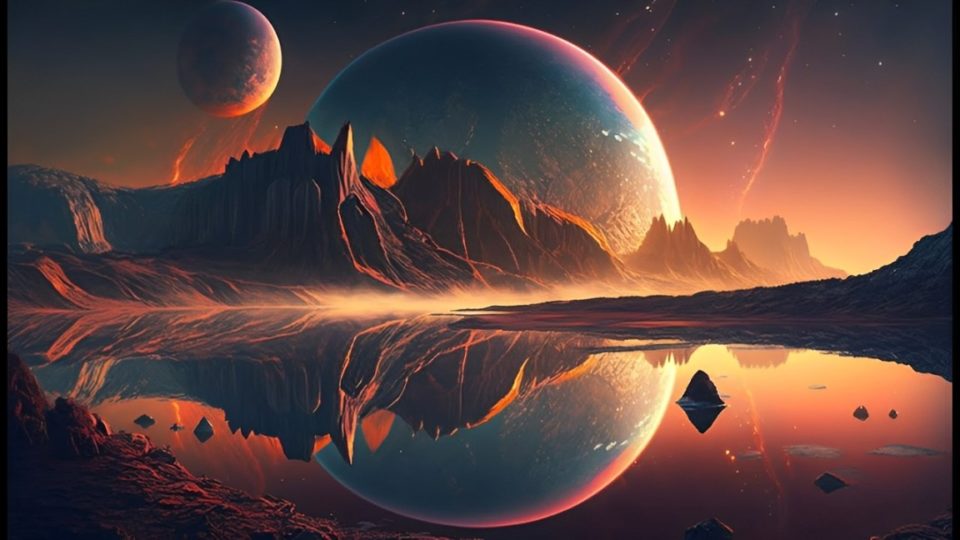
The universe is an unfathomable expanse, filled with mysteries that have captivated humanity for centuries. From the twinkling stars in the night sky to the distant galaxies that lie beyond our view, the cosmos is a realm of endless wonder. Embarking on a journey through space, whether through scientific exploration or personal contemplation, is a profound experience that reshapes our understanding of existence and our place in the universe.
The Beginning of Curiosity
For most of us, the fascination with the cosmos begins in childhood. Gazing up at the stars on a clear night, we feel a sense of awe at the sheer magnitude of the universe. This awe often gives rise to questions: What lies beyond our planet? How did the universe begin? These questions are the seeds of discovery, driving us to seek answers and expand our knowledge of the cosmos.
The journey through cosmic discovery is not a solitary one. Humanity has always looked to the heavens with wonder, developing tools and technologies over millennia to explore the stars. From the ancient astronomers who charted the movement of celestial bodies to modern scientists using powerful telescopes to peer deep into the universe, each generation builds upon the knowledge of those who came before.
The Wonders of Space Exploration
One of the most significant leaps in our understanding of the cosmos came with the advent of space exploration. The launch of satellites, rovers, and manned missions into space marked a new chapter in humanity’s quest for discovery. The Apollo missions, for example, took us to the surface of the Moon, allowing us to touch another celestial body for the first time. The iconic image of Earth, a small blue dot in the blackness of space, forever changed our perspective on our home planet and its fragility.
But the journey didn’t stop with the Moon. Space agencies like NASA, ESA, and private companies like SpaceX have continued to push the boundaries of exploration. The Mars rovers, the Hubble Space Telescope, and most recently, the James Webb Space Telescope have allowed us to peer deeper into space than ever before. These technological marvels have uncovered breathtaking images of distant galaxies, star-forming regions, and even exoplanets that may harbor life.
The Cosmic Perspective
While space exploration has expanded our understanding of the physical universe, it has also given us something equally valuable: perspective. The famous “Pale Blue Dot” photograph, taken by the Voyager 1 spacecraft, shows Earth as a tiny speck suspended in the vastness of space. This image reminds us of our smallness in the grand cosmic scale, yet it also highlights the uniqueness of our planet and the preciousness of life.
The more we learn about the cosmos, the more we realize how interconnected everything is. Stars, for instance, are the factories of the universe, creating the elements that make up planets, oceans, and even our bodies. We are, quite literally, made of stardust. This profound connection between humanity and the stars deepens our appreciation of both the cosmos and our own existence.
The Search for Life Beyond Earth
One of the most tantalizing questions in our journey through cosmic wonder is whether we are alone in the universe. The discovery of thousands of exoplanets — planets orbiting stars outside our solar system — has opened up new possibilities for finding life beyond Earth. Some of these exoplanets lie in the “habitable zone,” where conditions may be just right for life as we know it to exist.
The search for extraterrestrial life is not just about finding other beings; it’s about understanding the conditions that give rise to life itself. If life can exist on other planets, it could reshape our understanding of biology, evolution, and the uniqueness of Earth. The discovery of even the simplest microbial life beyond our planet would be one of the most profound discoveries in human history.
The Future of Exploration
As we continue our journey through the cosmos, the possibilities for discovery are endless. Missions to Mars, the outer planets, and even beyond our solar system are on the horizon. Advances in technology, such as faster propulsion systems and improved communication, may one day enable us to send humans to distant worlds and explore them firsthand.
Yet, while the physical journey through space is awe-inspiring, the true wonder of the cosmos lies in its ability to inspire us. The mysteries of the universe challenge us to dream bigger, to push the boundaries of what is possible, and to reflect on our own existence in new ways. In exploring the cosmos, we not only discover more about the universe — we discover more about ourselves.
Conclusion
The journey through discovery and cosmic wonder is, in many ways, a journey without end. The beauty of the cosmos lies not just in its vastness but in its ability to spark curiosity and inspire a sense of connection to something far greater than ourselves. Whether we look to the stars for scientific answers or for personal reflection, the journey continues, and the wonder remains.
In the grand tapestry of the universe, we are both explorers and dreamers, seeking to understand our place in a cosmos that will always hold more than we can ever fully comprehend.
